


Every week I send out an email to my Stonewood Writing Group with some ideas to help us improve our journal writing skills. These ideas will help you too if you’d like to try them. Below is the next installment of these writing lessons.
You can read previous lessons here:
If you’d like to join the group and receive these weekly emails, please let me know!
Here’s the next batch:

Stonewood Writing Group
Week 45
3 September 2026
Hello Writing Friends!
We’ve recently lost two great champions of this earth. A last week Dolly Parton died at age 80. Did you know that by the time she died last Tuesday, August 25, her Imagination Library had delivered more than 332 million books to more than 3 million children. For years, my grandchildren waited for the mailman to bring them books from Dolly. She was an influence for good in our family.

This week, on August 31st, Wendell Berry died at age 92. I am feeling the loss. I’ve taken some time today to write about the influence these two champions had in my life. Maybe you can do the same. Read their obituaries. Think about what you learned from them. Or write about another person who changed who you are in a significant way. Explain how you came to know them and what they said or did that moved you.
As you consider how their influence will live on in your life, think about how you want your influence to live on in the lives of your family members. Are your deeds and words being captured in a way that will outlive your mortal stay here?
Let me tell you a little bit about Wendell Berry. Among other things, he wrote stories set in a rural town he called Port William, fashioned loosely after the place where he grew up in Kentucky. There are many novels and short stories poems that touch on the people and life of this place. The chronology of the tales stretches from the United States Civil War to 2021. Within these stories you encounter both momentous and ordinary events in the lives of the people living there. These novels are dear. I have read and re-read most of them.
Wendell Berry wrote with great affection and respect about creation and love and “peaceableness,” about loving the soil we walk on, about community and faith – and about the absolute importance of paying attention – he was a wonder. Wendell Berry once said, “The only thing I try to accomplish in fiction is to show how people act when they love each other.” His words make me want to be better.
Here are 3 passages, with some thought questions to write about, from his book, Jaber Crow (one of my all-time favorites):
“Nearly everything that has happened to me has happened by surprise. All the important things have happened by surprise. And whatever has been happening usually has already happened before I have had time to expect it. The world doesn’t stop because you are in love or in mourning or in need of time to think. And so when I thought I was in my story or in charge of it, I really have been only on the edge of it, carried along. Is this because we are in an eternal story that is happening partly in time?”
Are there times in your life or experiences you’ve had that happened in unexpected ways?
“I can remember those early years when it seemed to me I was cut completely adrift, and times when, looking back at earlier times, it seems I had been wondering in the dark woods of error. But now it looks to me as though I was following the path that was laid out for me, unbroken, and maybe even as straight as possible, from one end to the other, and I have this feeling, which never leaves me anymore, that I have been led.”
As you look back on your life, are there times you did not notice then, but can now see you were led?
“I have come to the age now where I can see how short a time we have to be here. And when I think about it, it can seem strange beyond telling that this particular bunch of us should be here on this little patch of ground in this little patch of time, and I can think of other times and places I might have lived, other kinds of man I might have been. But there is something else. There are moments when the heart is generous, and then it knows that for better or worse our lives are woven together here, with one another and with the place and all the living things.”
Describe how you feel connected to your little patch of ground and the people woven together around you.
I am grateful for good people who leave goodness behind when they go. I am grateful for people like Dolly and Wendell, who I never met personally, but who have changed the way I see the world. What we do and what we say (write) can really make a difference!
Ann

Stonewood Writing Group
Week 46
10 September 2026
We’ve been back from our missionary service in Germany for 1.5 years now. I recently re-read the talk I gave in our congregation when we returned. It gave me a fun idea of a writing prompt for this week.
One of my favorite messages for missionaries comes from the booklet, Adjusting to Missionary Life, (p. 18). It says:
Serve from your strengths. Make a list of your strengths, talents, and spiritual gifts. Your strengths are part of the Lord’s storehouse, from which He draws to bless His children and build His kingdom. A crucial part of your mission is to cultivate your gifts and consecrate your strengths to help others come to Christ. Focus more on what you do well than on what you do wrong. Plan ways each week to develop and use your gifts to serve and bless others. (See D&C 82:18–19.)
I LOVE this counsel. It’s usually hard for us to say out loud what we are good at, but it’s important that we think about our own specific gifts and talents so we can figure out how to use them.
Heavenly Father created us. He gave us what we have. He made us who we are. He wants us to use our gifts to help or succor others.
King Benjamin spoke to his people and said:
Ye are eternally indebted to your Heavenly Father to render to him all that you have and are.
And also, ye yourselves will succor those that stand in need of your succor; ye will administer of your substance unto him that standeth in need. . . . (Mosiah 2:34; 4:16.)
He’s pretty specific that what we have and who we are is important. And there are people who need those very things–not in general, but specifically from YOU.
Our job is to figure out our gifts and how we can use them. Our job is also to notice gifts others have and appreciate them, compliment them and praise them. Miracles happen as we combine our gifts, talents and strengths to bless our families, our companionships, our ward family, our neighborhoods, and the Kingdom of God on earth.
Have you ever made a list of YOUR strengths, gifts, talents and interests?
Your Patriarchal Blessing will give you some ideas. Your mom or dad, friends, or spouse could probably suggest things they’ve noticed that you’re good at.
Elder Henry D. Moyle said:
“I have a conviction deep down in my heart that we are exactly what we should be, each one of us. . . . I have convinced myself that we all have those peculiar attributes, characteristics, and abilities which are essential for us to possess in order that we may fulfil the full purpose of our creation here upon the earth. . . . That allotment which has come to us from God is a sacred allotment. It is something of which we should be proud, each one of us in our own right, and not wish that we had somebody else’s allotment. Our greatest success comes from being ourselves.” (Improvement Era, December 1952, 934.)
Start your list today. Add to it as you think of things you enjoy doing that you’re good at. I hope this week you can each come up with at least 10 things to put on your list!
Happy reflecting!
Ann
You can read my whole Homecoming Talk here.

Week 47
18 September 2026
Twenty-five years ago, on September 11, 2001, our world changed.
Here is part of an email I sent to friends and family that evening:
Sent: Tuesday, September 11, 2001 9:51 PM
Subject: I’m in Manhattan, NYC 10:30pm
Greetings, Friends
It’s Tuesday, September 11, 2001, and John and I are sitting in our Hotel room on Times Square–we’ve just come in from a long walk in the city. We woke this morning to our clock radio at about 9:00 a.m., reporting that a bomb had gone off in the World Trade Center moments before. We rushed to turn on the TV and for the next few minutes/hours, we were glued to the TV watching what they are calling “America Under Attack.” The window in our room looks out to the west, the WTC is several blocks south of us. I went out into the hall on our 44th floor and asked a house keeper where I could go to find a southern view. She and I went into several vacated rooms, trying to get a view around the buildings next to our Marriott Marquis. On the corner of the building we found a window from which we watched the Towers burn. It was incredible. Minutes later the towers came down.
Here is a photo I took from the Marriott:

This day has been like a nightmare here. We have gathered with our friends in a small meeting room for much of the day feeling like we were watching a Mission Impossible-like movie on TV. The Pentagon was hit, planes were down, and out our windows, we saw smoke billowing for the rest of the day. People this morning stood down below in Times Square watching the big screen TVs that cover entire buildings–the feeling here was one of disbelief. . . .
You can read more here.
We were in New York for a week, feeling like our world had shifted in a frightening way. I saw many of the things described with my own eyes. I tasted the ash in my mouth and saw the streets of NYC empty and silent, except for emergency vehicles. It was a day I will never forget.


This month I have been reading The Only Plane in the Sky: An Oral History of September 11, 2001, by Garrett M. Graff, Holter Graham, et al. It’s a 2019 bestselling book that tells the story of the September 11 terrorist attacks through the firsthand accounts of nearly 500 people. These oral histories are built from transcripts, interviews, air traffic recordings, and personal diaries. They cover everyone from President George W. Bush and high-ranking officials to flight attendants, air traffic controllers, and families of victims. It is absolutely fascinating and chilling.

This book reminds me that when we are in the moment of any unexpected historic event, we usually do not know what will happen next. Some people in the top floors sat at their desks waiting for helicopters to rescue them. Some called their families. Some tried to evacuate. Then the buildings collapsed. Many did not see or know what was happening outside of the spaces they occupied. The fascinating first-person accounts in this book show what was going on in their minds from each limited point of view.
I remember the feeling that on September 11th, we had no idea what would happen on September 12th. We did not know if there would be more attacks. We did not know if our country would go to war. We did not even know who our enemies were. It was an unsettling feeling, looking into an unknown future.
This last week there have been many accounts and documentaries about 9-11 shared on social media and in the news. Things have been brought to our remembrance.
Where were YOU on that day? How did you hear the news? What were you doing at the time? Did you have children? How did you explain it to them? In what ways did your world, our world, change after that horrific day? Did you do anything special this year for the 25-year anniversary of 9-11?
Take some time this week and write about YOUR 9-11 experience. Explain what you can about it for your posterity. They will wonder what you thought of that historic day.
Happy writing, my Friends!
Ann

Stonewood Writing Group
Week 48
24 September 2026
Hello Friends!
We have lost another Writing Champion this month. From Wikipedia: Annie Dillard (née Doak; April 30, 1945 – September 15, 2026) was an American author, best known for her narrative prose in both fiction and nonfiction. An “American naturalist”, she published works of poetry, essays, prose, and literary criticism, as well as two novels and one memoir. Her 1974 book Pilgrim at Tinker Creek won the 1975 Pulitzer Prize for General Nonfiction. From 1980, Dillard taught for 21 years in the English department of Wesleyan University, in Middletown, Connecticut.
I loved reading Pilgrim at Tinker Creek many years ago. More recently I re-read An American Childhood. In my review on Goodreads, I wrote: This is a great memoir. Beautifully written, insightful, thoughtful. The words are masterful. I especially loved the chapter describing her mother and the one about the outdoor games she played as a child. The last part of the book was a little bit less rewarding–about the angst of the teen world. It didn’t seem to resolve into a better place before the book ends (about when she graduates from high school). I wish it kept going and I wish she’d keep writing.
I think Annie Dillard and Zippy would have been great friends as girls.
This books makes me want to be a better writer.
Annie Dillard also wrote a book for writers called The Writing Life (pub. 1989). It’s good. I will share some tips from that book below (or see the attachment kindly made by AI). I always love learning from other writers. You might want to pick up one of her books.
Annie Dillard gave this advice to aspiring writers: “Spend it all, shoot it, play it, lose it, all, right away, every time. Do not hoard what seems good for later . . . give it, give it all, give it now. The impulse to save something good for a better place later is the signal to spend it now. Something more will arise for later, something better. These things fill from behind, from beneath, like well water. Similarly, the impulse to keep to yourself what you have learned is not only shameful, it is destructive. Anything you do not give freely and abundantly becomes lost to you.”
This advice makes good sense to me. I think about it often when I do family history work. What if I had waited for films to be digitized and not spent years pouring over and transcribing microfilms? Because I did that work then, I can do other work now. What we do now builds on what we have already done. What we have already written frees us to write something else now. Waiting to get your stories out is never a wise idea. There are no guarantees that our future will be better for us than this very moment. (Is your memory improving? Do you have more time and energy? Are your technical skills getting better?) NOW is the best time to write!!
If there a story you are waiting to tell–don’t wait until you can write it perfectly. Are you holding stories in your heart, saving them for later (when you have nothing else to do) to write them? You may think that your writing will only improve, so why not wait until you’re more confident with your words. If you put off writing your stories until you have time, until you retire, until you’ve done more research, until the kids are grown, until your life slows down, you will probably never write them. Get your words out NOW. If you must, save the editing for later, if you live that long. If you knew you were going to die next year, what would you write now? Think about it, then get after it.
Annie Dillard also said:
“Write as if you were dying. At the same time, assume you write for an audience consisting solely of terminal patients. That is, after all, the case. What would you begin writing if you knew you would die soon?”

Here is some advice from The Writing Life:
10 Things Annie Dillard Can Teach Us About Writing
1. Follow the Writing Where It Leads
Don’t decide in advance exactly what your story is “supposed” to be. Start writing and see what emerges. Sometimes the real subject appears only after you begin.
Try this: Begin with, “The thing I remember most about that day is…” Then follow the memory wherever it takes you.
2. Embrace the First Bad Draft
Writing involves trial and error. You have to put words on the page before you can discover what the piece really wants to become.
Try this: Write freely for 15–20 minutes. Don’t worry about grammar or perfection. Just get the words down.
3. Be Willing to Throw Things Away
Not everything you write needs to survive. Sometimes you have to write several pages to discover the one paragraph—or even one sentence—that contains the heart of the story.
Try this: After writing, underline the one sentence that feels most alive. Ask yourself, “Could this be the real story?”
4. Spend Your Best Material Now
Don’t save your best memories, observations, ideas, or stories for some imaginary future book. Use the good material now.
Try this: Think of a favorite memory or story you’ve been saving. Write it now. Give it a home in your current work.
5. Write About What Fascinates You
Something doesn’t have to seem important to everyone else to be worth writing about. An ordinary object or memory may contain extraordinary meaning for you.
Try this: Ask yourself, “Why can’t I stop thinking about this?” Then write about it.
6. Pay Close Attention
Dillard’s writing reminds us that careful observation can create a story. Notice sights, sounds, smells, textures, objects, expressions, and small details.
Try this: Take a familiar place or event and describe it in as much sensory detail as you can. What might you have overlooked?
7. Trust the Page to Teach You
You don’t have to know exactly how to write your story before you begin. Writing itself teaches you what the story needs.
Try this: Write the story first. Let the writing show you what it wants to become.
8. Don’t Worry About Speed
There is no “right” speed for writing. A short writing session that produces one honest paragraph can be more valuable than hours of forcing yourself to produce pages.
Try this: Set a timer for 20 minutes. Write without stopping. When the timer goes off, stop—no matter how much or how little you’ve written.
9. Take the Writing Seriously
Dillard compares words to tools—a miner’s pick, a woodcarver’s gouge, a surgeon’s probe. Writing can help us dig beneath the surface of our experiences and discover what we didn’t know was there.
Try this: Choose a question, a feeling, or a mystery from your life. Write about it—not because you know the answer, but because you want to discover it.
10. Let the Process Be a Gift
Writing isn’t only about producing something for other people. It can be a way of paying attention, remembering, discovering, and seeing your own life more fully.
Try this: Notice something today—small or large—that makes you feel more alive. Write about it.
A Thought to Take With You
Pay attention. Follow the line. Tell the truth. Let the writing surprise you.

——————
I hope knowing Annie Dillard a bit better is helpful to you. Think about these practical tips this week and try some of her suggestions. See where your writing leads you. Don’t put it off. Just sit down and get started!
Ann
Stonewood Writing Group
Week 49
1 October 2026
Hello friends! I hope your busy summer routines are settling into some more peaceful Fall-ish days where you can sit a bit more and relax a bit more and WRITE a bit more! This is my favorite time of year, and for us, it’s the calm before the storm of our next move. It’s looking like we’ll be in the neighborhood for a few more weeks before our new home is finished across town.
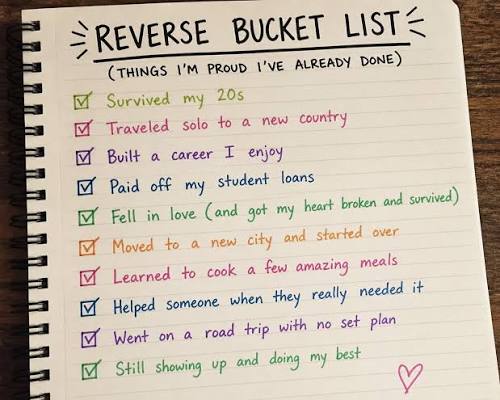
I read a very interesting article this week in Time Magazine (published on 29 September 2026) written by Angela Haunt. It’s about Reverse Bucket Lists. When I went to find it online, I discovered many people are writing about this idea right now, and there are lots of suggestions out there. You may want to take a look. Below is the article I read:
Why You Should Make a Reverse Bucket List
Your bucket list is probably full of big dreams: go sky-diving, learn to speak Italian, finally take that trip to see the northern lights. You might think that all that possibility should give you something to look forward to—but spend enough time staring at everything you haven’t done, and your yet-to-be-checked off aspirations can start to feel like more proof you’re somehow behind.
That’s what bothered Simon Sinek, who hosts the podcast A Bit of Optimism and is the author of books including Start With Why, about the concept of a bucket list. “You’re staring at a list of things you’ve never done, and it’s kind of depressing,” he says. “Even if you make your way through the list and things come off, you die with a list of things you’ve never done. And that just leads to disappointment and regret.”
About 15 years ago, in a small act of rebellion, Sinek started keeping a reverse bucket list: a log of all the wonderful things he’d already experienced, like the time he saw a complete rainbow instead of just part one.
Sinek keeps his list on his phone, where he sometimes stumbles across it while searching for something else. Then he gets sidetracked revisiting his own life and remembering experiences he’d forgotten about. “It’s joy scrolling,” he says. “Why shouldn’t I get credit for these things that showed up organically in my life?”
Here’s how to take stock of the big milestones and small moments worth remembering—and give yourself a chance to enjoy them all over again.
How a reverse bucket list can help you feel more fulfilled
A reverse bucket list works because it interrupts one of your brain’s most stubborn habits: always looking ahead to what’s next instead of pausing to appreciate what’s already happened. “So much of daily life is focused on the next goal, the next milestone, or the next thing we haven’t done yet,” says Rachel Needle, a psychologist in West Palm Beach, Fla. That translates into rarely stopping long enough to notice “everything we’ve already experienced, survived, learned, or built.”
Making the list gives you a reason to notice the lovely, surprising, unexpectedly funny things that happen in the middle of an ordinary day, which are easy to miss when you’re already thinking about what’s next. When you start actively seeking out these moments, you may find that you spend more time celebrating what’s already part of your life, rather than dwelling on what’s missing.
“Instead of thinking, ‘I’m not there yet,’ you begin noticing, ‘Look how much is already part of my story,’” Needle says. “That shift alone can change how you see your life.”
Keeping track of these experiences can be especially helpful for people who feel perpetually behind or tend to compare themselves with others. “We get lost in what everyone else is doing, so we forget what we’re actually doing,” says Alyssa Kushner, a licensed clinical social worker in New York. Writing down your own personal highlights gives you something to revisit when it feels like everyone else is having a better time. She keeps her old journals for precisely that reason: They remind her of the friends, trips, and fun she might otherwise overlook. Rereading them gives those memories a little more time and attention. “You’re feeling it and you’re savoring it,” she says.
“Those reminders may lift your mood and support your self-esteem, too—especially when you recognize your own role in making something good happen. As Kushner puts it: “I did take that risk. I did build that friendship. I did get through that season.” When it’s easier to focus on what’s going wrong, the list offers concrete reminders of what’s gone right.
What to put on your reverse bucket list
Aim to make your entries specific, whether the experience was big or small. For example, you might record a Tuesday dinner with friends: “Everyone stayed at the table chatting for three hours.”
There’s room for big milestones (an awe-inspiring trip or promotion at work) as well as what Kushner describes as “micro moments of joy.” “These are the daily things that happen that we might kind of gloss over, but that are just as important,” she says. “Maybe it was a beautiful morning and you got to soak in the sun, and you had your coffee or your matcha, and you just felt content. It could be a random five-minute exchange with a stranger that was a really nice moment of connection. It could be something you felt proud of yourself for.” Every time she sees flowers, for example, she feels happy.”
Include a few details that help you return to the scene, Kushner suggests: what you saw, heard, or felt, and what made it worth remembering. Maybe you caught the scent of flowers on your walk or laughed so hard with a friend that you forgot what started it.
You can also give yourself credit for things that didn’t come with a souvenir or a celebration. Needle suggests including challenges you’ve overcome, relationships you’ve nurtured, and moments when you did something that took courage. “You’re more resilient than maybe you’re giving yourself credit for on a regular basis,” she says. On her own list: finishing her book proposal, reconnecting with friends, and planning a trip to London with her mom.
The point is to choose what mattered to you. As Needle puts it: “You’re not trying to prove anything to yourself or anyone else that you lived an impressive life.”
“How to make—and revisit—a reverse bucket list
Keep track of these memories in a journal or notebook, or on your phone—whatever you’re most likely to return to. Treat it as a living document that grows as you have new experiences and remember old ones you’d almost forgotten.
If you like a little structure, Needle suggests a weekly check-in: Add whatever comes to mind, then spend some time rereading old entries.
Or take Sinek’s approach and skip the schedule. He adds things when they happen. “There’s no rules here,” he says.
Whatever your system, make sure you periodically revisit what you’ve written. Linger over an entry long enough to remember what made you laugh, who was there, or how you felt. As Needle puts it, the point is “letting yourself feel good about it again.”
Excerpt From “Why You Should Make a Reverse Bucket List” by Angela Haunt, TIME.
https://apple.news/AyAcZ_IOvSuSxfWOiPwK_5A
This material may be protected by copyright.
————————
This idea sounds good to me. We don’t always go back and re-read our journals, but we might glance through a list kept in our phones when we need a reminder of the good things in our lives. I’m going to start my list. I hope you might start a list too. This seems to me like the perfect time of year to look back, remember, and notice the beauty and good around us.
If you want some help getting started, here are a few ideas:
Start with the big milestones
What are five things I have done that I once wondered if I could actually do?
What are some major decisions I made that changed the direction of my life?
What have I accomplished that younger-me would be surprised or proud to know about?
What difficult season of my life did I make it through?
What have I learned to do that I couldn’t do when I was younger?
Think about experiences
Where have I been that I never expected to visit?
What are some adventures I have had—planned or completely unexpected?
What is something I did simply because I wanted to experience it?
What is one day or trip I wish I could put in a bottle and keep forever?
What is something I tried for the first time—and what do I remember about it?
Think about people
Whose life have I touched in some meaningful way?
Who has made my life better, and what did we experience together?
What relationships am I especially grateful I had?
When did someone trust me, need me, or believe in me?
What have I done as a mother, grandmother, daughter, sister, friend, or spouse that I feel good about?
Look for the small accomplishments
What ordinary things have I learned to do that once seemed difficult?
What have I created with my own hands?
What traditions have I started or carried forward?
What have I done that brought joy to someone else?
What small accomplishment am I secretly quite proud of?
A few favorite topics
What moments in my life have made me think, “I can’t believe I’m actually here”?
When have I been brave?
When have I surprised myself?
What did I say yes to that turned out to matter?
If I could show a scrapbook of my life to someone who knew nothing about me, what moments would I definitely want included?
As you think about things that have happened in your life for this list, forget chronology. Set a timer for 10 minutes and simply finish these sentences:
“I have…”
I have traveled to…
I have raised…
I have made…
I have learned…
I have survived…
I have loved…
I have helped…
I have built…
I have dared to…
I have seen…
I have forgiven…
I have begun again…
I have laughed until…
I have experienced…
Don’t worry about whether something is “important enough” to make the list. The reverse bucket list is yours. Fill it with things like: A homemade quilt, a child’s first day of school, seeing the ocean for the first time, learning to drive, finishing a degree, hosting Thanksgiving, climbing a mountain, helping a friend through a hard time—all of them belong if they matter to you.
I have a feeling this writing project will be a sweet experience as we move towards our upcoming Thanksgiving season. Have fun with it!
Ann

Stonewood Writing Group
Week 50
8 October 2026
Hi My Writing Friends!
This week, I’m giving you only two questions to write about. The first is an interesting topic that I’ve thought about more and more as I’ve gotten older, moving into the retirement years of my life.
Write about the things you will miss when you die. You can make a list or describe things that come to mind.
Here are some things I came up with. What would be on your list?
What I will miss when I die
I will miss feeling the ache of tiredness after a long hard day. I will miss seeing the grit that makes people strong. I will miss not knowing how things turn out, wondering, hoping, feeling a little anxious. I will miss the smells of earth and dirt and weeds. I will miss wondering what heaven will be like, wondering if I got it right, if I did enough. I will miss living in this tension of uncertainty, hoping for a better place, sacrificing to get there. I will miss rationing things to make them last long enough. I will miss buying something new because the old one wore out. I will miss living in hard places. I will miss imperfections that make things interesting. I will not miss waste or extravagance for no purpose. I will not miss struggling to communicate in another language. I will not miss my Heavenly Mother any longer.
The second question is what do you want to leave behind when you die? Think of about 5-10 things you hope will outlive you. Are they lessons you taught your kids? Are they physical items or objects from your life? Are they journals? Photos? Heirlooms? What do you want to leave behind to help your descendants remember you?
Ray Bradbury, in Fahrenheit 451 said:
“Everyone must leave something behind when he dies, my grandfather said. A child or a book or a painting or a house or a wall built or a pair of shoes made. Or a garden planted. Something your hand touched some way so your soul has somewhere to go when you die, and when people look at that tree or that flower you planted, you’re there.
It doesn’t matter what you do, he said, so long as you change something from the way it was before you touched it into something that’s like you after you take your hands away. The difference between the man who just cuts lawns and a real gardener is in the touching, he said. The lawn-cutter might just as well not have been there at all; the gardener will be there a lifetime.”
Think about things you can do now to prepare the things you want to outlast you. You might want to write down some instructions, or make some labels, or tell your kids now what is important to you. This isn’t something we should put off until later. In a coming week, we’ll talk more about creating an “If I Die” list for your family. For now, just start thinking about these important things.
Ann

Stonewood Writing Group
Week 51
15 October 2026
Forty-five years ago today, on 15 October 1981, I left on my first Mission for The Church of Jesus Christ of Latter-day Saints. I was headed to South Africa, speaking Afrikaans. Every year on this day, I remember that day and the many things I loved about my missionary service.
Because I am thinking about this today, maybe if you served a mission, you can think about it too. If you had a different kind of adventure, adapt these questions and write about that instead. Perhaps it was a job, or a church calling. Perhaps it was a trip you took, or another place you lived. Perhaps it was Marriage or Motherhood. See what you can come up with.
Or you might interview a child or another family member who served a mission and help them capture their memories and experiences.
Missionary service is a wonderful topic to write about because it includes people, places, challenges, surprises, spiritual experiences, humor, growth, and the person you became afterward. Here are some prompts that bring back very specific memories and some that invite deeper reflection.
Missionary Memories & Service — Writing Prompts
1. The Call
What do you remember about receiving your mission call? Where were you? Who was with you? What did you feel when you read the words that told you where you would serve?
2. The First Day
Take us to your very first day as a missionary. What did you see, hear, smell, eat, wear, or worry about?
3. The Place
Describe the place where you served as if you were introducing it to someone who has never been there. What made it memorable?
4. Someone I Will Never Forget
Write about one person you met on your mission who has remained in your memory. What was it about that person that stayed with you?
5. The One Who Taught Me
Tell about someone you went to teach but who ended up teaching you something important.
6. A Door That Opened
Write about a time when an unexpected opportunity, conversation, friendship, or teaching experience opened a door for you.
7. A Door That Closed
Was there someone you hoped would listen or accept the gospel but didn’t? What did that experience teach you?
8. My Companion
Choose one companion and tell a story that captures what your relationship was really like—not just the official version.
9. The Hardest Day
Describe one particularly difficult day of your mission. What made it hard? What helped you get through it?
10. The Funniest Moment
What is one missionary experience that still makes you laugh?
11. Something That Went Wrong
Tell about a time when nothing went according to plan. Looking back now, what do you remember most?
12. A Small Miracle
Write about a small event that may not have seemed extraordinary to anyone else but felt significant to you.
13. The Moment I Knew
Was there a moment when you felt especially certain that you were supposed to be where you were? Describe it.
14. A Prayer I Remember
Write about a prayer you offered—or heard—that you have never forgotten.
15. The Person I Was Before
Who were you when you left on your mission? What were you like emotionally, spiritually, socially, or in your confidence?
16. The Person I Became
In what ways did missionary service change you? What did you learn about yourself that you didn’t know before?
17. Something I Left Behind
What did you miss most while you were away? A person, food, holiday, family tradition, activity, place, or ordinary comfort?
18. Something I Took Home
What did you bring home from your mission that wasn’t in your suitcase? A habit, belief, friendship, perspective, scripture, phrase, or lesson?
19. The Last Day
Describe your final day as a missionary. What did you feel as you realized that this chapter of your life was ending?
20. Looking Back
What part of your missionary experience do you remember with the greatest fondness today?
21. What Changed Me?
Of all the experiences you had as a missionary, which one changed the direction of your life or changed the way you saw yourself?
22. The Lesson I Didn’t Understand Yet
What did your mission teach you that you didn’t fully understand at the time—but understand differently now?
23. The People Who Changed Me
Make a list of three to five people from your mission who influenced you. Then choose one and write about why.
24. What I Know Now
If you could sit down with yourself on the day you entered the mission field, what would you tell that younger missionary?
25. If I Could Relive One Day
If you could return to one day, one conversation, one meal, one walk, one teaching appointment, or one ordinary afternoon from your mission, which would you choose—and why?
26. The Photograph That Isn’t in the Album
Think of a missionary memory that was never photographed. Perhaps it was a particular person’s face, the sound of a door closing, walking down a street at sunset, sitting in a missionary apartment, laughing with your companion, eating an unfamiliar meal, or saying goodbye to someone. Describe that “photograph” with words.

Stonewood Writing Group
Week 52
22 October 2026
Hello Friends!
In the last few weeks, I’ve been to a few funerals for friends who have died unexpectedly. It always stops me short when someone leaves us without warning. Two were children and two were adults my age, all hit by cars while biking. Tragic. For those my age, I wonder if they said all they wanted to say before departing. Did they write all they intended to write for their posterity? Did they finish their work here on earth? If granted one more week, what would they do with that time? If granted 5 more pages, what would they record?
Every year, I pick a theme for my year and put it on the first page of that year’s journal. Here’s what wrote at the beginning of this year:
EACH DAY ISN’T ONE MORE . . . IT’S ONE LESS.
I think about that all the time. At first this year, it was about time in our family home. But it’s really about a whole lot more. It’s about time on Earth. It’s about time to “leave myself behind.” These words remind me to keep going, to say everything I want to say, to record my stories and my experiences, to express my love to friends and family.
When an unexpected or even an expected death occurs, I always wonder what was left undone. Were there things that prepared the family for this family change? Were words discovered that brought comfort? If you were to suddenly go Home, what would your family find in your absence? Do they know where your words are saved?
Have you posted your important photos and documents to your Memories in FamilySearch?
Have you posted a short life history and other important words in FamilySearch?
This week do something more to prepare for your Departure. Hopefully it won’t be for a long long time. But we can do a few things to get ready for it. If you use a computer, create a file in your documents. I gave mine the name “IF I DIE.” I’ve let my husband and kids know it’s there.
Here are a few ideas of things you might write down or list for your family:
Funeral program ideas, including music you love, speaker ideas, things you’d like included. Is there a favorite thought, scripture or poem you might want printed on the funeral program?
A chronology of the major chapters in your life and a list of important things you accomplished for your obituary.
A list of life-changing moments in your life.
A list of family heirlooms in your possession, their descriptions and meanings to you, and your intentions for each.
Financial information. You can find lots of help for every aspect of this online.
IDs and Passwords to your accounts.
Where to find your journals or journal files and what you would like to see done with them.
Have you hidden anything important anywhere?
Letters to your loved ones.
There are many other things you might include. Most of these including writing things down and having them recorded. What things will your family want to know that you haven’t told them?
It’s also important to talk with those closest to you and make all your wishes known. Talk to those whom you’ve designated, as well as those close to you whom you did not designate. Do this to explain why your decisions were made and to avoid any lingering questions or hurt feelings.

Here are a few pics I took at the funeral of my dear friend, Mary Ellen Edmunds.
Here is one more idea. Whenever I attend a funeral (no matter how well I know the person who died), I like to photograph the displays of that person’s life. There is usually a lot of thought put into showing a representation of a family member’s life. After the funeral, all of the gathered photos and personal items are taken down, divided and dispersed among family members.
I like to photograph these displays and post the photos in that person’s FamilySearch Memories so they will not be lost. It only takes a few minutes and the memories will last forever. You can do the same. If you need help posting the photos, call me.
I hope this topic isn’t troubling. We can make things easier by being prepared. My mom died unexpectedly on Halloween in 1998. She was 68 years old. In a few months I will turn 68. I don’t expect to “shoot on over” for a long time, but when I do, I hope my words will be helpful to those left behind.
Words, recorded, need never die.
Ann
Stonewood Writing Group
Week 53
29 October 2026
Hello my Friends!
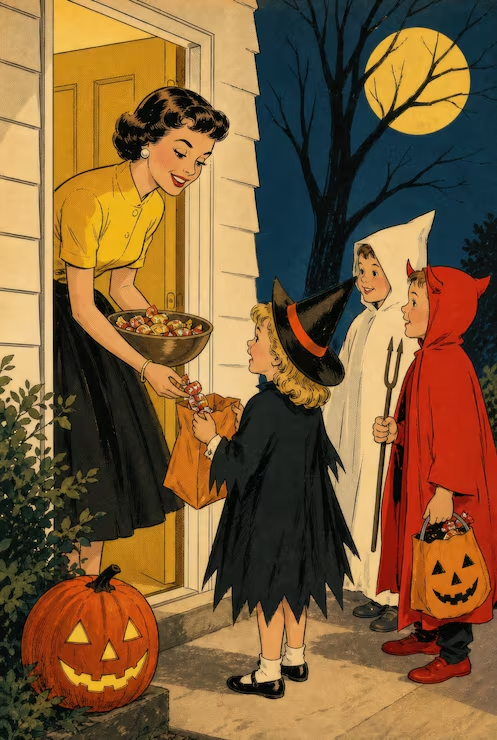
This week we’ll talk and write about our memories of Halloween. Halloween is such a wonderful way to dive into personal history writing because it brings back so many vivid childhood details: the costumes we wore, the houses we visited, the candy we collected, the neighborhood children, the traditions our mothers created, and even the fears and superstitions that seemed so real when we were young.
Halloween has been especially fun for us this year because we have grandkids nearby to celebrate with. I’m feeling the excitement again as I watch their anticipation. In our culture, Halloween is more than a holiday. It is a season that lasts for several weeks. And when we look back, it’s a little window into the world we grew up in.
This week take some time to write some of your Halloween memories. Below are some ideas that will help you remember past Halloweens.
Remembering Halloween
What did Halloween look and feel like when you were growing up, and what do those memories tell us about the time and place where you lived?
What did the air feel like? Was it cold? Were the leaves falling?
What did your neighborhood look like?
What were the decorations like?
What costumes did you wear?
Who helped you get ready?
What did you carry to collect candy?
What were you most excited about?
Describe the costumes you made or saw as a child. Were they homemade or store-bought?
Describe the decorations your family put out. Indoor? Outdoor?
Describe the treats your family gave out. Were they homemade or store-bought?
Describe the adventures you had (walking in the dark, going door to door, visiting grandparents, neighborhood friends, older siblings, getting lost, being frightened).
Describe the celebrations (school parties, bobbing for apples, costume contests, church activities, neighborhood parties, haunted houses, family gatherings).

How Halloween has changed
Think about what’s changed since you were a child. Describe these changes.
Halloween then Halloween now
Homemade costumes ………………………..Elaborate purchased costumes
Homemade decorations …………………….Elaborate outdoor displays
Walking around the neighborhood……..Organized trunk-or-treat events
Pillowcases for candy ……………………….Special Halloween bags
Homemade popcorn balls …………………Individually wrapped candy
Parents often stayed home ……………….Parents often accompany children
Neighborhood traditions …………………Community and school events
Did children have more freedom to roam the neighborhood when we were young?
Were we more easily frightened by Halloween decorations and stories?
What traditions have disappeared?
What traditions have become better?
What do today’s children experience that we never did?
What do you wish had never changed?
A few more Halloween writing prompts
Pick a few of these topics and write a bit about them. You don’t have to respond to all of them. Just have fun re-living some of your memories and jot down what comes to mind.
The Halloween I Remember Best
Write about one particular Halloween that stands out in your memory. What happened? Who was there? What made it memorable? Include the little details that bring the evening back to life.
Halloween was a time when ordinary things could become frightening. Did you ever scare yourself? Were there houses you were afraid to approach, stories that frightened you, or costumes that seemed terrifying?
Write about the mother, grandmother, sister, or other woman who helped make Halloween special. What did she do? Did she sew costumes, bake treats, decorate the house, or organize the festivities? What do you appreciate about her now that you might not have appreciated then?
Write about Halloween through your five senses. The crunch of leaves, the smell of a candle inside a pumpkin, the feel of a scratchy costume, the taste of a crisp caramel apple, the sound of children laughing in the dark.
The Halloween That Didn’t Go as Planned
Did a costume fall apart? Did you lose your candy? Did someone get frightened or sick? Did it rain or snow? Was there a Halloween mishap that became a family story?
Describe what you would want to experience one more time about Halloween as a child. Who would you want beside you? What would you wear? Which house would you visit?
What Halloween traditions did you carry into your own family? Which ones did you change? What do you hope your children or grandchildren will remember about Halloween in your home?
When I Was Afraid of the Dark
My very first Halloween costume.
The best Halloween candy I ever tasted.
The neighbor’s house everyone wanted to visit.
The Halloween when it snowed.
A costume I desperately wanted but never got.
My favorite Halloween photograph.
The first Halloween I took my own children trick-or-treating.
A Halloween party I will never forget.
The year I was too old to trick-or-treat.
What Halloween taught me about being brave.
A Halloween tradition I wish we still had.
The Halloween sound I can still hear.
The person who made Halloween magical.
The year I became the mother making the costumes.
A Halloween memory I had almost forgotten.
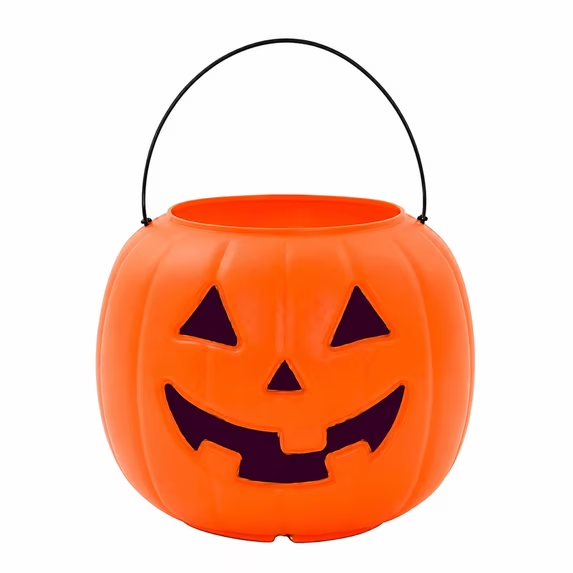
Choose one of these objects and write for five minutes about what it brings to mind.
Candy bucket
Halloween mask
Old sheet
Jack-o’-lantern
Caramel apple
Popcorn ball
We sometimes think that ordinary childhood experiences aren’t important enough to write down. But someday, a grandchild may be fascinated to learn what Halloween was like before elaborate decorations, trunk-or-treats, and today’s traditions. Those ordinary details are often the very things that make personal history precious.
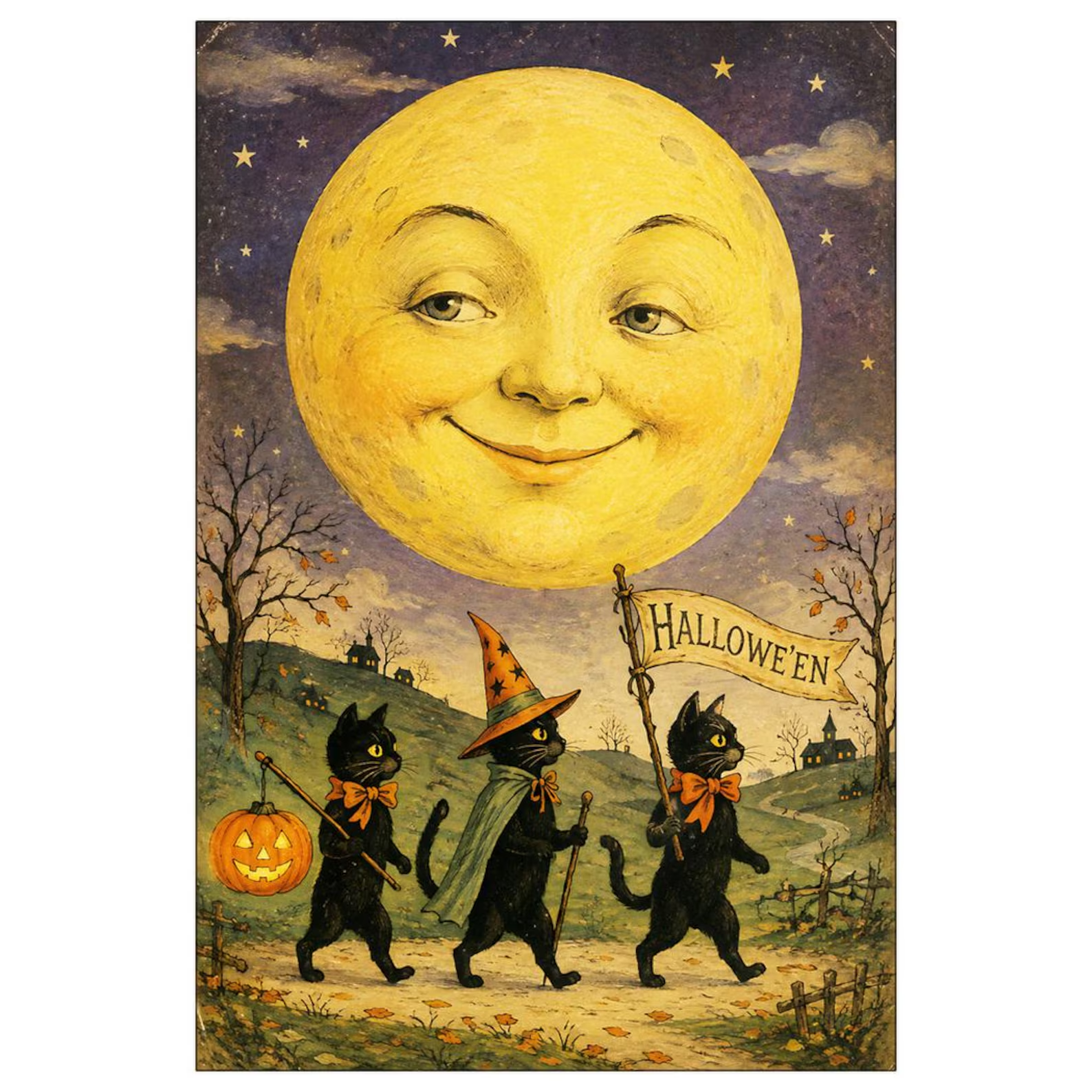
Here is an example of some of my own Halloween memories:
Halloween in the Country
written 21 November 2005
Growing up on a farm had its drawbacks, especially at Halloween time. We had few neighbors, and none of them seemed to have children. Mrs. Wolff was on the north, a widow who rented her side apartment to college boys from Iran. Mrs. Wolff always gave me cool Iranian stamps from their letters. The Wiebe’s were across the street from her. They kept to themselves. They had older kids who went to Immanuel High, the Mennonite high school. Our farm came next, then Grandma’s.
The Stockdale’s driveway was across from Grandma’s. Mrs. Stockdale was a nurse. I’m not sure what Mr. Stockdale did. He went around without a shirt on and had long stringy hair, dyed black, and a big belly. They weren’t farmers, but they rented the house from the Wiebe’s and had a big barn and lots of animals. Mr. Stockdale got sick animals from auctions and brought them home to try to nurse them back to health and then resell or butcher them. Many died and were thrown out in the back fields where they lay in Halloween grotesqueness, bloated and covered with flies. We rode our motorcycles out there and always came across rotting unburied sheep, goats, or calves. It was frightening.
The Stockdales adopted 2 mentally handicapped boys. They were about our age. I don’t remember them going to school. The whole farm was a bit scary with the pigs and cows and chickens underfoot, and sick animals and the boys.
South of Grandma’s house was where the Reimers lived, a quiet older Mennonite couple, who later moved to town and sold their house to Leo Balakian, a man who sold fertilizers and had no weeds in his orchards.
That was about it for neighbors within walking distance. We lived 3 miles from town on Road 52. Our only hope for any kind of candy at Halloween was to go where the candy was–in town. So we dressed in our homemade costumes and took our orange pumpkin buckets and went to town, where Mom or Dad would drop us at one end of a street and pick us up at the other end. We went to neighborhoods we knew to be safe, places where our school friends lived.
I remember once a lady was not very nice to us at the door when we said “trick-or-treat.” I felt a bit mad at her and on the way down the sidewalk, I kicked her gravel rocks onto the sidewalk. I’ve never forgotten that I returned an unkindness with the same. I shouldn’t have done it.
When we got home from our trip to town, we’d line up our pumpkin buckets on the fireplace hearth before examining the contents. Then we rationed our candies for as long as we could, hiding them in our rooms until much of the candy went stale.
I don’t remember many of the costumes we came up with–typical things like ghosts and hobos and gypsies. My most creative costume was a robot that I made out of cardboard boxes for my head and body. I pained gages on the front and cut arm holes in the sides. I painted the whole thing silver and put antenna on the top. We had a Ward Halloween party that year at church and I got to wear it and show off my creativity.
Other years we had Mutual parties at our house which included hay rides with the tractor pulling vineyard wagons filled with hay. Paul remembers one year the Teacher’s Quorum made a witch out of Brother Charters’ milk can. It had a face with a witch’s nose made out of a sponge. The wart on the nose was the red button you pushed to make the green hot chocolate come out the nostril. They loved making it. I remember hot chili and bobbing for apples and fun games set up in our emptied-out garage.
As we got older and trick-or-treating no longer appealed to us, Mom tried to introduce us to finer Halloween activities like pulling taffy or making caramel apples. Dad never liked Halloween much and when he was Bishop he put a stop to Spook Alleys at the Church, which had been quite popular for the youth until that time. He didn’t feel that was the type of activity to be held in a church.
I don’t think anyone ever came trick-or-treating at our house. We went to Grandma’s and she usually gave us a little plastic bag with a cookie and a few candies in it, tied with a twisty tie. We didn’t go to the other neighbors, they didn’t expect us.
Mom always liked Halloween and decorating for it. She even chose Halloween as her day to die. She had all her decorations out, and bags of treats for each grandchild ready and waiting. Then she spooked us all by making an unexpected departure. I think she went out with a smile.
Happy Halloween to each of you!
Ann
Stonewood Writing Group
Week 54
5 November 2026
Happy November!
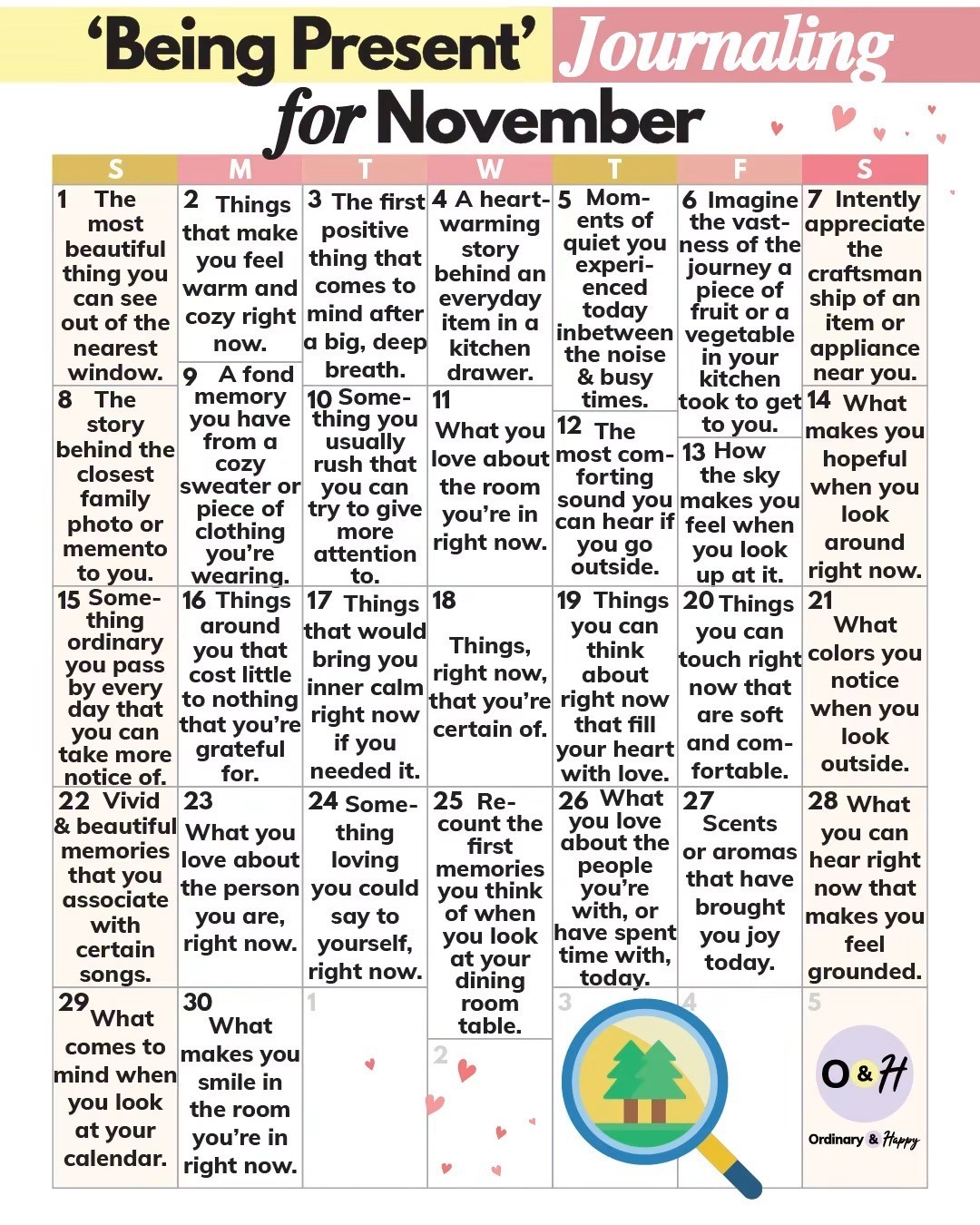
I found this sheet of writing prompts floating through my Facebook feed a few days ago, and I think it’s worth sharing. It was posted by a group called “Ordinary and Happy.” They have lots of fun writing prompts you can find here.
Join me in writing about these prompts this month, one each day. They are comfortable and thoughtful and you can write as little or as much as you’d like. I know we’re a few days into the month, but you can go back and start at the beginning.
Here is what I wrote a couple of days ago on November 2nd:
Monday, November 2nd
“Things that make you feel warm and cozy right now”
Yesterday daylight savings changed, bringing darkness to us sooner in the day. It was a drizzly wet day with leaves falling in the rain outside. Today is much the same. I love sitting in the corner chair in our cozy Farm House family room, right next to the fire. There is a small table by my fireplace chair with an old lamp on it and a couple of books I’m reading.
One of these books is by Gladys Taber, my mother’s favorite author. It’s about her family buying and restoring an old Revolutionary War-era country home in Connecticut. Her words are like comfort food, a collection of stories from her diaries compiled by her children, describing this place they called Stillmeadow. It was a simpler time, when apples hung ripe on the trees in the meadow and meals were cooked in a pot hanging over a fire. Cold winters blew in with deep snow drifts and the children hung handmade decorations on the Christmas tree. The seasons changed and the children and puppies grew up, happy there.
This paragraph in the introduction warmed my heart as much as the fire warmed my feet. Gladys’s daughter wrote of her 2 daughters: “Now, at sixteen and thirteen, they spend a good deal of time browsing through the books their grandmother has written about Stillmeadow. “Aren’t we lucky,” says Anne, “that Gram likes to write.”
I sit by the fire, cozy and warm, reading her words, loving Gladys, wondering if perhaps someday my granddaughters will say the same of me. The hope in my heart that they will brings me great joy and warms me through and through.
Below are the daily prompts, ready to copy and paste into your journal:
Sunday, November 1st – “What is the most beautiful thing you can see out of the nearest window?”
Monday, November 2nd – “Things that make you feel warm and cozy right now?”
Tuesday, November 3rd – “The first positive thing that comes to mind after you take a big, deep breath.”
Wednesday, November 4th – “A heart-warming story behind an everyday item in a kitchen drawer.”
Thursday, November 5th – “Moments of quiet you experienced today in between the noise and the busy times.”
Friday, November 6th – “Imagine the vastness of the journey of a piece of fruit or a vegetable in your kitchen took to get to you.”
Saturday, November 7th – “Intently appreciate the craftsmanship of an item or appliance near you.”
Sunday, November 8th – “The story behind the closest family photo or memento to you.”
Monday, November 9th – “A fond memory you have from a cozy sweater or piece of clothing you’re wearing.”
Tuesday, November 10th – “Something you usually rush that you can give more attention to.”
Wednesday, November 11th – “What you love about the room you’re in right now.”
Thursday, November 12th – “The most comforting sound you hear if you go outside.”
Friday, November 13th – “How the sky makes you feel when you look up at it.
Saturday, November 14th – “What makes you hopeful when you look around right now?”
Sunday, November 15st – “Something ordinary you pass by every day that you can take more notice of.”
Monday, November 16th – “Things around you that cost little to nothing that you are grateful for.”
Tuesday, November 17th– “Things that would bring you inner calm right now if you needed it.”
Wednesday, November 18th – “Things right now that you’re certain of.”
Thursday, November 19th – “Things you can think about right now that fill your heart with love.”
Friday, November 20th – “Things you can touch right now that are soft and comfortable.”
Saturday, November 21st – “What colors you notice when you look outside.”
Sunday, November 22nd – “Vivid and beautiful memories that you associate with certain songs.”
Monday, November 23rd – “What you love most about the person you are, right now.”
Tuesday, November 24th – “Something loving you could say to yourself right now.”
Wednesday, November 25th – “Recount the first memories you think of when you look at your dining room table.”
Thursday, November 26th – “What you love about the people you’re with or have spent time with today.”
Friday, November 27th – “Scents or aromas that have brought you joy today.”
Saturday, November 28th – “What you can hear right now that makes you feel grounded.”
Sunday, November 29th – “What comes to mind when you look at your calendar.”
Monday, November 30th – “What makes you smile in the room you’re in right now.”
Enjoy this cozy month of gratitude and family as we head into winter. It’s a good time to write.
Love to you all,
Ann

Stonewood Writing Group
Week 55
12 November 2026
Hello Friends!
Below is an interesting essay written by a man named Richard. When I found these words, I copied them into my journal, because I relate so well to what he said. He calls our generation a bridge between what our grandkids call “the olden days,” and today’s world full of technology. I read something last week that said, “It’s weird when you realize we are the last generation on this Earth to know what life was like before social media.” So many things have changed during our lifetimes.
This week make a list or write about 10 things that have changed, affecting your life. These are the kinds of things that will be especially interesting to your kids and grandkids, because they are foreign to them. Do you have any stories to tell about how we used to do things? Our generation really is a bridge between two very different eras of time.
This piece will give you some ideas of things to think and write about:
My name’s Richard. I’m 74. I sometimes think our generation is the bridge between two worlds — one made of dirt roads and handwritten letters, the other made of satellites and screens in our pockets.
I was born in a house without air conditioning. Summer meant open windows and the hum of a box fan. We knew the neighbors by name, and if your bike chain broke, you knocked on any door until someone found a wrench. We grew up on patience — waiting for the mail, waiting for the library to open, waiting for the radio to play our favorite song again.
Then the world sped up. Phones shrank, music became invisible, and the news didn’t take days to reach us — it arrived in our palms before we finished breakfast. We learned to type, to swipe, to tap. We learned to talk to machines and have them talk back. We learned… because we always had to.
We’ve seen milk delivered to the door in glass bottles, and we’ve scanned groceries without a cashier. We’ve dropped coins in payphones and made video calls across oceans. We’ve known the sound of silence — no buzzing notifications — and the sound of an entire world pinging at once.
Sometimes younger folks think we’re behind. But here’s what I know: our generation knows both worlds. We can plant tomatoes and write an email. We can tell a story without Google, and then fact-check ourselves with it. We know the weight of a handwritten letter because we’ve held it, and we know the reach of a message sent in seconds because we’ve pressed “send” and watched a reply arrive from thousands of miles away.
We are proof that you can change without losing yourself. That you can honor where you came from while learning where the world is going.
We’ve buried friends and welcomed grandchildren. We’ve watched diseases disappear and new ones arrive. We’ve known paper maps and GPS, postcards and emojis, patience and immediacy.
And maybe that’s our real gift — we carry the memory of a slower, quieter world, and the skills to navigate the fast, loud one. We can teach the young that not everything needs to happen instantly… and remind the old that it’s never too late to try something new.
We are the bridge. The middle chapter. The link between what was and what will be.
The original author of the viral essay “We Are the Bridge” is anonymous. While the narrator introduces himself simply as “Richard, 74,” no full name or verified original creator has ever been identified.
This month, celebrate the good changes. There are many things we once did, made easier now by technology. There are jobs we no longer do. There are products we no longer need to buy. We have more discretionary time and less physical labor. Which of the changes you’ve seen in your life are you most grateful for?
Happy November!
Ann