Here is my next installment of Journal and Writing lessons from the Stonewood Writing Group that started in September 2025. I prepare and send a lesson every week to friends who want to improve their journaling. If you’d like to join us, please let me know.
Previous lessons can be found here:
And here:

Stonewood Writing Group
Week 25
9 March 2026
Hello, Friends!
This week we’ll talk about a fun way to write using one word prompts. You may think that fabricating something to write about is silly or a waste of time. Trust me, it’s not. Any words you record are better than no words you record! Remember: “Write Once, Read Forever!” A prompt is like the handle on a faucet that turns and starts the flow of water. Your words are like the water–sometimes they need to be set free, they need permission to flow.
I have 2 dear friends. We started a small 3-person writing group a couple of years ago. We meet weekly in a FaceTime chat for about 1.5 hours. We give each other assignments and when we’re together we read what we’ve written to each other. We cheer each other on as we get our stories out.
Last month we decided on our project for this year. Last year we responded to the 100 prompts in The Book of Alchemy by Suleika Jaouad, the year before we did the 52 Lists of Happiness by Moorea Seal.. Another book we share is The Encyclopedia of an Ordinary Life by Amy Krause Rosenthal. Her approach to writing a personal history is to do it alphabetically. I LOVE this approach and am preparing my own personal history with this format. If you don’t have that book yet, GET IT. It’s one of the most fun personal histories I’ve ever read.
Rather than writing chronologically, she organized her history by short interesting random topics. By the end of the book, you know her like you know your best friend. Her book was published in 2005. I literally cried when I learned she died of cancer in 2017. I felt like I lost a dear friend. Thank Goodness she got her words out!
So, my 2 writing friends and I have decided to write and compile our own Encyclopedias, while we still have our wits about us. We will pull from personal essays and experiences we have already written, journal stories, and recorded memories, organizing them all into a fun alphabetical mix of our words and stories.
Our project this year will fill in some cracks in our alphabetical collections of words. We decided that each week we will give each other 5 words beginning with a letter of the alphabet. We each choose our own words, starting with A. My first words, for example were: Artichoke, Apps, Ashes, Artwork and Aardvark. My friends gave me these words: Alone, Advocacy, Alfalfa, Angel, Appearance, and Anticipation, Awed, Addicted, Authentic, Aversion.
You can see these words are all over the board and create some interesting topics to write about. Sometimes we choose a word we WANT to write about, other times they are random things that we know will create something worth recording. When we respond to each others’ words, we step out of our own boxes a bit. Then when we get together each week, we read what we’ve written and have a real good time cheering each other on. Sometimes our responses to words are similar, sometimes completely different. In either case, reading them together sparks more ideas or things we might tweak in our own writing. We have a good time doing this.
Another good idea, if you don’t do this with a friend, is to ask ChatGPT something like this:
Please give me 15 one-word prompts, all starting with A, chosen specifically to nudge personal essay–style writing (interior, reflective, grounded in lived experience).
ChatGPT quickly spits out a list of words, for example here are the D words from that prompt that you can choose from:
Departure
What did you leave behind — and what left you?
Devotion
To whom or what have you given your steady, ordinary loyalty?
Disappointment
When did reality fail to match the story you had told yourself?
Desire
What longing shaped your choices before you fully understood it?
Doubt
When did uncertainty become a teacher rather than an enemy?
Discipline
What daily practice quietly built the person you are becoming?
Distance
Where has space — physical or emotional — changed a relationship?
Discovery
What did you find that you weren’t even looking for?
Defiance
When did you resist expectation, and what did it cost you?
Delay
What unfolded later than you hoped — and why might that have mattered?
Dependence
When have you had to lean more heavily than you were comfortable with?
Damage
What has marked you — visibly or invisibly — and how do you carry it?
Daughter
How has that role shaped the way you see yourself?
Dwelling
Where have you truly felt at home — and why?
Deliverance
When did relief arrive, and what did it teach you about endurance?
I respond to as many of these extra prompts as I have time for each week.
Just to give you an idea of what this kind of writing might look like, here are some examples from my A and B words. This is quick writing, the first thing that comes to mind. You can always go back and touch them up, edit or add a bit more.
Artichoke –one of my very favorite specialty vegetables. I find myself waiting for artichoke season. They were plentiful at vegetable stands in California. Here, the nicest ones I find at Costco. I steam them, 4 in a pot on a steamer basket, then we enjoy eating them, sliding each petal over a pat of butter on the edge of our plates. The heart is the prize after all the work, also eaten with butter, salt and pepper. Yum!
Apps –A relatively new part of our lives with cell phones. The apps on my phone that I use the most are Gospel Library, News, Calculator, Scriptures (for other languages), Healthy (tracks all my health and body stats), Weather, Notes, Calendar, Maps, Snapchat, Google Chrome, Safari, Spotify, Messenger, Find My Friends, Kindle, Audible, Facebook, Duolingo, Text Messages, LDS Tools, BeReal, ChatGPT, Google Maps, iWatch, Google Translate, Family Tree, WhatsApp.
All of these things help make my world a little bit easier and keep things at my fingertips. They’re amazing gifts, really.
Here’s my friend’s response to Apps:
Apps are an amazing phenom in our era. And there seems to be an “applicaton” for anything you need help with. An app that helps you find your keys or another that helps you track where your kids are geographically. You can see if they are home doing homework or they are actually at a sporting goods store. Apps can help you navigate directions while driving or adjust photos and visually repair torn and ancient photos. They can make you look as young or old as you choose. One app I have come to depend on is google Maps. It’s a location/destination finder. You plug in the address of your intended destination. It tells you how many miles away it is and calculates how long it will take to arrive (going all recommended speed limits). But not only that, it offers three potential routes but defaults to the “fastest” one. Then, as you drive, it tells you how long to stay on the current roadway, then (when functioning properly, it notifies you ahead of time where you need to turn next and the name and/or number of the road and gives the exit off of the freeway offramp. It tells you where things are most congested along the route, where there’s an accident and if there is a “safety check” (cops checking for speeders.). It has saved my hide many times regarding which route to take in my commute to work.
By way of reference, when I was a kid, GPS was more like this: Buying a map at a gas station. Having the person in the passenger seat be “the navigator” and guide the driver as you went along.
Having the female repeatedly ask the male to pull over and ask someone for directions, while the male pride went full blown, silently refused or loudly bellowed that he knew where he was or he’d figure it out. Subsequently, hours were spent with unintended “touring.”
Getting detailed written directions in advance from the person you were going to see.
Calling from a payphone when lost to find out where you were and how to get back on route.
Getting lost.
Arriving Late.
Giving up.
Ashes –When we were kids, we had several barrel incinerators out in the back behind the packing shed. We burned our trash there, usually at night when no one would detect the smoke (in case it was a no-burn day). When the ashes in the barrels were too full, we’d spread them in the fields. We did the same with ashes from our fireplace.
We had a separate dumpster (built by Dad) that was like a large wooden box the size of a pallet where we threw tin cans and glass. When the dumpster was full, we’d take a trip to the county dump.
Artwork –Recently, I discovered Brian Kershisnik’s painting called “Harrowing of Hell. It depicts Jesus in a bloodied white robe forcing the jaws of hell (a dark monster with jagged teeth) open with his cross. Spirits are emerging from within the monster’s mouth, and shown escaping to freedom. I keep this painting up on one of my monitor screens while I do my Family History work.
Aardvark –on my first day in the MTC, where I learned to speak Afrikaans, our teacher told us, “did you know you already know one word in Afrikaans?” The word was Aardvark, which literally means “earth pig.” That was the beginning of my love affair with the Afrikaans language.
Here are some B words my friends gave me. These are fun because they are not pre-meditated:
Bloody– so many painful and heartbreaking emotions return when I remember the 6 miscarriages I suffered through, watching every day for blood, fearing I’d see some. I watched for blood for many years, even after I had my last miscarriage, always feeling relief when there was none.
Bedtime –I am seldom asleep before 1:00 a.m. I try to be in bed by midnight, but I usually read messages, news, and my Facebook feed before going to sleep. I average 7.5 hours of sleep a night.
Blossoms – I loved growing up in the “Fruit Basket of the World,” California’s Central Valley. Our farm was in the heart of it, our home was surrounded by orchards–plums, peaches and nectarines. In the spring, our area was famous for “the Blossom Trail,” and people came from miles around to follow the markers through the orchards and farms. One of my favorite fragrances is plum blossoms–sweet, delicate and heady. It’s hard to exhale, when all you want to do is inhale the fragrance.
Belly –my least favorite body part. It never pleases me.
Broomstick –when I lived in Eket, Nigeria, we had a little friend named Doraty Bassey Davies Udoeyo, but we called her “Broomstick.” She was a little waif, 9 years old and very undernourished. She weighed 23 pounds. Her arms and legs felt like broomsticks. She’d sit on our laps and felt like a feather. I often wonder if she survived her childhood and if she did, where she is now. When we gave the children de-worming pills, her mother, Helen, came running the next morning to get us. We followed her to their family compound where she proudly showed us a banana leaf with 63 roundworms on it that Doraty has passed that morning. Those worms were living on what little food she received from the family stew pot.
Blisters –when I was in high school, I had some sort of injury in my upper thigh that bothered my swimming. One night I took a heating pad and wrapped my thigh, securing the pad with an ace bandage before I went to bed. In the morning when I woke, my leg was bright red and soon several large blisters formed. I had 3rd degree burns on my inner thigh. For several days I tried to drain them without popping them by inserting a needle under the skin from outside the blister. I didn’t want them to become infected. One day I was at school and the somehow the school nurse found out about the blisters. They were quite ugly and my skin was discolored. She was very concerned about the burn. I told her I had things under control. For several years after that, I had burn scars on my thigh where the blisters had been.
Braid– Grandma Elsa had long white hair that she could almost sit on. I loved watching her brush it as she sat at her vanity with the large round mirror (now in the Farm House). She’d always pull the hair from her brush and wrap it around her finger and put it on the doily on the vanity. Grandma would make one long silver-white braid, then wrap it into a bun, and secure it with hairpins that were a grayish color. Then she’d push hair combs into her hair on top at the front to give the look a little body because her hair was thin, like mine. Sometimes she’d use bluing in her hair or something like Dippity Do to give it a little umph. Grandma said she’d never in her life cut her hair short, she just trimmed the ends of her braid. I loved Grandma’s hair.
Black widow –for 3 years I kept a pet black widow in a canning jar in my kitchen window. All summer long neighborhood kids would come over to help me feed her (Sophie) flies and bees from our gardens. I think black widows are beautifully elegant and intriguing.
See also black widow story:
I hope this gives you some fun writing ideas for times when you feel your life might be boring or uninteresting. Or if you just get tired of writing about your daily routines, add in a few prompts. Make them intentional (write about things you want to write about), or totally random. Try to respond to at least a few prompts this week–choose any you like and have fun with them!
Happy writing,
Ann

Stonewood Writing Group
Week 26
26 March 2026
Hello my Writing Friends!
Have you had fun coming up with some prompts to write about? I sure hope so. Start small and easy with a prompt or two each week. Add more as you have time. Type them right into your journal, just to add a bit of interest. You can gather them all in another document or place if you like.
This week I want to share something I recently read in a BYU Speech called “Fuller Understanding” given by Marion D. Hanks on 16 November 1982. It moved me and made me think about how reading words written by others inspires jumy own words. I especially love when a simple account makes me see things in a new light. That’s what I hope my words will do for someone someday.
Here is an excerpt from Elder Hank’s talk where he shares his feelings after reading a journal entry by David Grayson:
Importance of One Day
Among the wonderful ideas I was blessed to run across last night, some of which I’m going to share with you, is this page with three or four short paragraphs to which I ask you to listen with interest because It’s worth it. From David Grayson, a favorite and beloved friend, whom I know through his books, I read:
This is a well earned Sunday morning. My chores were all done long ago, and I am sitting down here after a late and leisurely breakfast with that luxurious feeling of irresponsible restfulness and comfort which comes only upon a clean, still Sunday morning like this—after a week of hard work—a clean Sunday morning with clean clothes, and a clean chin, and clean thoughts, and the June airs stirring the clean white curtains of my windows. From across the hills I can hear very faintly the drowsy sounds of early church bells, never, indeed, to be heard here except on a morning of surpassing tranquility. And in a barnyard back of the house Harriet’s hens are cackling triumphantly. They are impiously unobservant of the Sabbath Day.
I turned out my mare for a run in the pasture. She has rolled herself again and again in the warm earth and shaken herself after each roll with an equine delight more pleasant to see. Now, from time to time, I can hear her gossipy whickerings as she calls across the field to my neighbor Horace’s young bay colts.
When I first woke up this morning I said to myself:
“Well, nothing happened yesterday.”
Then I lay quiet for some time—it being Sunday morning—and I turned over in my mind all that I had heard or seen or felt or thought about in that one day, and presently I said aloud to myself:
“Why, nearly everything happened yesterday.”
And the more I thought of it the more interesting, the more wonderful, the more explanatory of high things appeared the common doings of that June Saturday. I had walked among unusual events—and had not known the wonder of them! I had eyes, but I did not see—and ears, but I heard not. It may be, it may be, that the Future Life of which we have had such confusing but wistful prophecy is only the reliving with a full understanding of this marvelous life that we now know. To a full understanding this day, this moment even—here in this quiet room—would contain enough to crowd an eternity. Oh, we are children yet—playing with things much to large for us—much too full of meaning.[Baker, Ray S., Adventures in Friendship, by David Grayson (pseud.) (New York: Doubleday, Page & Co., 1910), pp. 173–75]
Last night at midnight, having done my reading and thinking and praying, I took this pad and single-spaced on it events that had happened during the day. It had been an uneventful day, a day which was supposed to be a kind of a catch-up day, a preparing day for a full week and what is to follow, a think day, a put-together day, a day for refurbishment in a sense, a day of quietness, maybe even a day at home. But when I had noted all that occurred, in the spirit of Grayson’s motivating thoughts, I had a long list of exciting and important events to remember and consider.
Let me mention only one. A neighbor from across the street knocked on the door in the evening with a very apologetic look on her face and said, “My sister was using our telephone, or I would have called first, Mr. Hanks. Do you have an egg we could borrow?”
I invited her into the kitchen and showed her our vast wealth in eggs. We had a dozen and three. I said, “Will you take the dozen or the three?”
She said, “We only need one.”
I said, “Well, you can’t leave here with only one.” So I gave her the box with the three, took her to the door, and sent her on her way, smiling and happy, to go home and tell her mother that she had three eggs. I can almost imagine the conversation. “But I sent you for one,” and all the rest.
Do you know how exciting that is? These great people are here from Taiwan. Their daddy is a professor at the university. They are a wonderful family, and I had the great blessing of sending her home with three eggs. One day she will replace the eggs, and our friendship will be firmer and better.
I met Bob Cundick on his way out of the temple. He has his index finger broken and in a cast. You students know who Dr. Cundick is? He plays the tabernacle organ. I said to him, “How could anybody be so dumb as to break his first finger when he is an organist?” We laughed, he told me about it, and I went on my way.
Well, out of all of this, what happened in that uneventful day when nothing happened—when, in fact, everything happened? I’ve been thinking about the fuller understanding that will come and that may amount, as David Grayson said, to what heaven really is. Out of it came a couple of ideas I’d like to share. What is this fuller understanding? What are the principles which will become far more significant in that “Future Life” of which Grayson spoke? I believe that there are three fundamental elements in life that need to be thought about. . . .
—————–
I love how this shows the gems found in a simple day that might not be recognized or captured if we don’t pay attention to them. That “fuller understanding” is something I want to seek more of as I move through ordinary days.
It reminds me of this example that came to me one ordinary day as I watched a bluebird pull a worm from our yard:
This week read something someone else has written. Do you have any ancestral journals? Check the Memories in Family Search on the pages of your family members. Do you have a favorite author? Maybe revisit a memoir you’ve read and enjoyed. If you haven’t read “Zippy” yet by Haven Kimmel, it’s a fun memoir to start with. Think about how their words flow through you and what feelings they bring to your heart. Let them change you. Then write something about those feelings or impressions and how they have moved you, like Elder Hanks did. Awareness and writing make us better people.
Enjoy your week. Let’s hope for some rain!
Ann

Stonewood Writing Group
Week 27
2 April 2026
Last week John and I attended a BYU Emeriti event where our dear friend, Steve Lund was the guest speaker. As you know he served as the General Young Men’s President until last year. He began his remarks by telling us about how he was called to that position after a phone call from Pres. Nelson’s Executive Secretary. He was asked to come to Pres. Nelson’s office the next morning at 10:00. The invitation was a shock to him.
Then he told us about the first time he was asked to speak in General Conference. As he tried to prepare for his talk, his mind was blank and he just sat staring at his computer screen waiting for words that never came. He prayed for revelation to know what to say. What he said next gave me pause. He said that the Spirit very quietly spoke Heavenly Father’s words to him: “I’ve already given you revelations. Look in your journals.”
Steve said that he learned to fill his talks with stories and experiences he had already had and had recorded in his journal. One of my favorite Steve Lund talks is called “Flashes of Light,” given at BYU on 20 September 2020. If you haven’t read it lately, it’s worth your time. He describes a transformative experience on a bridge he had once on a business trip in Asia where, he said, he knew more than he knew.
You can find his talk here.
This reminds me of an experience I had as we prepared to serve as Mission Leaders in Yakima in 2015. In the weeks before we left, we learned that our friends, Glen and Elisabeth Mella, who were serving as Mission Leaders in California, were home for a few days for some special training. I think it was about rolling out smart phones in our missions. We arranged to visit them in their home on a Sunday afternoon before they returned to San Jose.
I remember asking Elisabeth about how she prepared for all of the talks and trainings she had to give as a Mission Leader. I wondered if she just prepared a few talks, and then gave them several times each as they rotated through the stakes and zones. I was trying to wrap my head around how I would need to prepare to speak to congregations and missionaries during our 3 years in the Yakima Mission.
I’ve never forgotten what she told me that afternoon. She said, “you know, every week something happens that gives me content for the next talk I have to give. I seldom give the same talk twice.”
I thought about that for a long time before we arrived in Yakima and I determined that I would trust Heavenly Father to give me experiences I could draw from so that each time I spoke, my content would be new and fresh. I kept a list of all the talks and trainings I gave during those 3 years. There were more than 200! And every single week, things happened, or memories of previous experiences (in my journals) filled my heart and mind with content. It was miraculous!
Last week I wrote about having a “fuller understanding” and being aware of the quiet miracles happening in our lives on ordinary days. These are the experiences that move us, if we notice them. These experiences provide content for our journals.
So this week, pretend you’ve been asked to speak at church, or at BYU, or at General Conference, based on an experience you’ve already had (recorded or not yet recorded in your journal). What have you learned? What would you share? What experiences have you had that have made you who you are? What can I, or others learn from YOU?
Take some time to think about this and record your message to the world. Then, going forward, practice looking for messages each week as you live your ordinary lives. Record those gems in your journal. You may need them someday as you visit with a friend needing comfort, or a grandchild, or a loved one struggling through hard times on a mission. Heavenly Father is giving us revelations every day, every week, every year. Are we capturing them???
Ann
Stonewood Writing Group
Week 28
9 April 2026
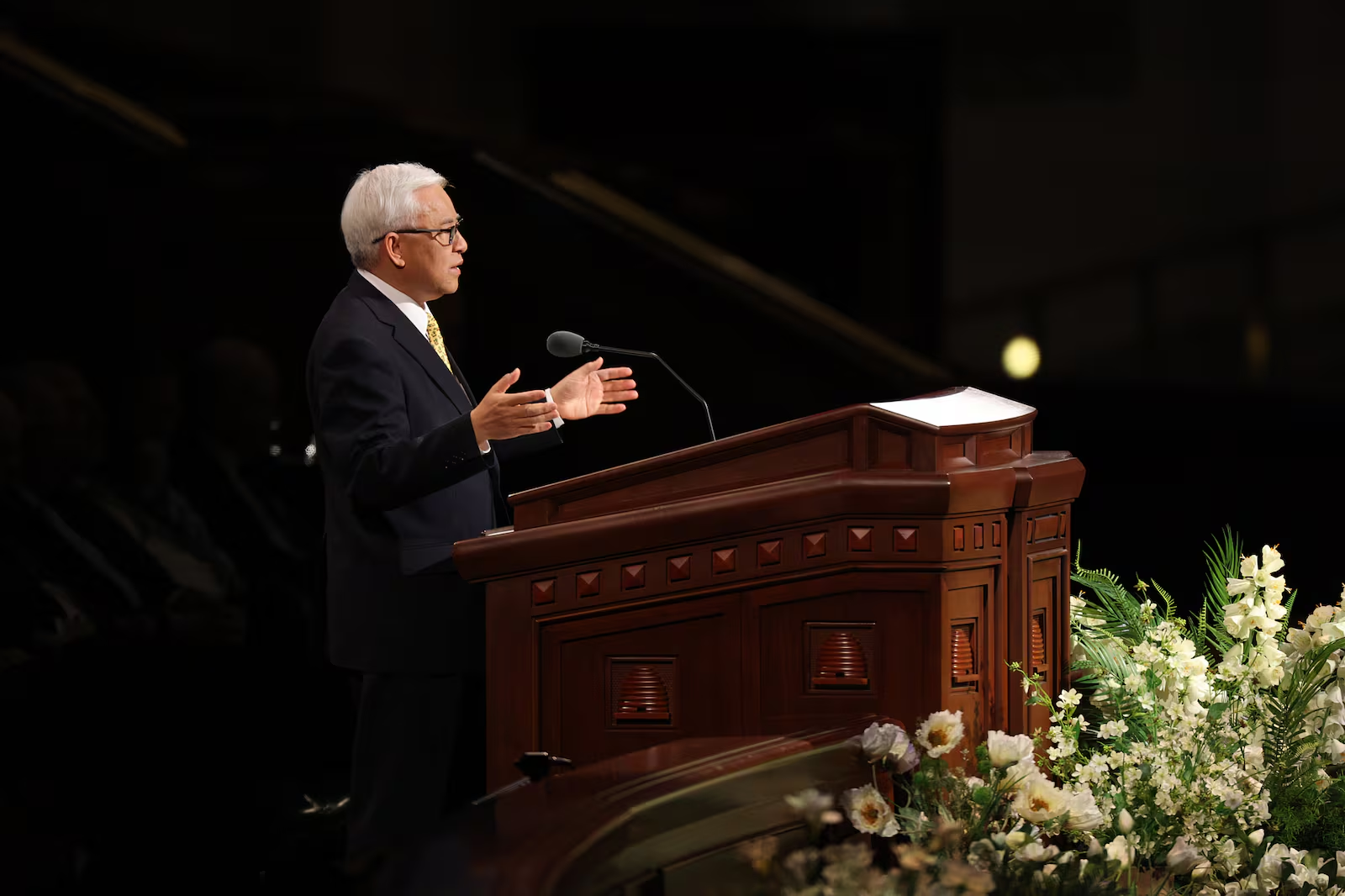
I hope you all enjoyed listening to General Conference last weekend. YOU were one of the things on my mind as I listened this time. I wondered if there might be any messages for our little SWG writing group.
Then, on Sunday afternoon, the message came. It was from Elder Dhi Hong (Sam) Wong Of the Seventy. His talk is called “Remember, Remember.” You can read it here.
He introduced his thoughts by asking, “What would God want us to remember?” My journal mind stopped right there, and I wrote those words down. He went on to share 5 “Remember, Remember” scripture passages from the Book of Mormon.
I’ve been thinking all week about what God would want ME to remember. I am starting a list and I will try my best to see that the things on my list are recorded. Maybe you can join me in this writing experience. Give it some thought. What are the important things you have learned or experienced that you don’t ever want to forget?
If it’s not written, it’s as if it never happened. Let’s keep our memories safe by recording them.
Ann

Stonewood Writing Group
Week 29
16 April 2026
Hello my Writing Friends!
This last week I got to speak in a neighboring ward about Journal Writing. It was fun to meet more good women who are interested in improving their writing skills. A few of these women will be joining us. You are all welcome here.
This week I want to share some words from a writer, Anne Lamott. She is an American novelist and non-fiction writer, born 10 April 1954. She wrote a national bestseller on writing called “Bird by Bird.” About this book, she said, “”Thirty years ago my older brother, who was ten years old at the time, was trying to get a report on birds written that he’d had three months to write. [It] was due the next day. We were out at our family cabin in Bolinas, and he was at the kitchen table close to tears, surrounded by binder paper and pencils and unopened books on birds, immobilized by the hugeness of the task ahead. Then my father sat down beside him, put his arm around my brother’s shoulder, and said. ‘Bird by bird, buddy. Just take it bird by bird.'”
This is some of the best journal-writing advice I’ve ever received. Bird by bird, day by day. If you are keeping up with the challenge to write for 8 minutes each day, you will see that it doesn’t take long for your flock of words to gather and take flight. Don’t let a feeling of recording everything now overwhelm you. Just take it bit by bit. A grocery list, a prompt, a memory, a little description, a piece of dialogue, a to-do list. Just get started and keep it going! If you run out of ideas, read back through our emails and find something you haven’t done yet.
Here’s a wonderful collection of thoughts on writing by Anne Lamott:
10 Thoughts by Anne Lamott on Writing
1. My gratitude for good writing is unbounded; I’m grateful for it the way I’m grateful for the ocean.
2. You own everything that happened to you. Tell your stories. If people wanted you to write warmly about them, they should have behaved better.
3. We write to expose the unexposed. If there is one door in the castle you have been told not to go through, you must. The writer’s job is to turn the unspeakable into words – not just into any words, but if we can, into rhythm and blues.
4. For some of us, books are as important as almost anything else on earth. What a miracle it is that out of these small, flat, rigid squares of paper unfolds world after world after world, worlds that sing to you, comfort and quiet or excite you. Books help us understand who we are and how we are to behave. They show us what community and friendship mean; they show us how to live and die.
5. Don’t be afraid of your material or your past. Be afraid of wasting any more time obsessing about how you look and how people see you. Be afraid of not getting your writing done.
6. Writing and reading decrease our sense of isolation. They deepen and widen and expand our sense of life: they feed the soul. When writers make us shake our heads with the exactness of their prose and their truths, and even make us laugh about ourselves or life, our buoyancy is restored. We are given a shot at dancing with, or at least clapping along with, the absurdity of life, instead of being squashed by it over and over again. It’s like singing on a boat during a terrible storm at sea. You can’t stop the raging storm, but singing can change the hearts and spirits of the people who are together on that ship.
7. I don’t think you have time to waste not writing because you are afraid you won’t be good at it.
8. You are lucky to be one of those people who wishes to build sand castles with words, who is willing to create a place where your imagination can wander. We build this place with the sand of memories; these castles are our memories and inventiveness made tangible. So part of us believes that when the tide starts coming in, we won’t really have lost anything, because actually only a symbol of it was there in the sand. Another part of us thinks we’ll figure out a way to divert the ocean. This is what separates artists from ordinary people: the belief, deep in our hearts, that if we build our castles well enough, somehow the ocean won’t wash them away. I think this is a wonderful kind of person to be.
9. Almost all good writing begins with terrible first efforts. You need to start somewhere.
10. Because this business of becoming conscious, of being a writer, is ultimately about asking yourself, How alive am I willing to be?
—————–
I hope you have a great week! Thanks for your notes and emails. What we are doing is important!
Ann

Stonewood Writing Group
Week 30
23 April 2026
Hello Friends!
Today’s interesting topic is Artificial Intelligence and how it affects our world, especially our writing world. Here’s a sad excerpt from my journal, written last 31 December 2025 after spending the holidays with some of our kids:
I read an article in my BYU college magazine yesterday. Artificial Intelligence is changing our world and I’ve been thinking a lot about AI and ChatGPT this week, after being around the kids. It’s an interesting time to be a parent. We are considered obsolete, not wise; we are uninformed, not experienced. Our kids today do not turn to us for help or advice. They are quick to look things up on their devices and quick to believe AI knows best. No one asks our opinion or wants to know what we think. We really are considered obsolete and unimportant. It makes me feel sad. I think that’s part of the reason why I write. I want my voice heard, but wonder if it ever will be. I am questioning this week, if I really even matter. It’s good we die before this goes on too long. I don’t think I could bear to be ignored for 20 more years.
I’m happy to be feeling better since that journal entry, but I’m glad I captured the FEELING of what it’s like to be the parent of kids growing up with Artificial Intelligence at their fingertips.
I want to share with you the article I read that day. It’s an important read. You can find the full article online here.
Connections Magazine 2025
College of Family, Home, and Social Sciences
The Human Sciences in a World of Artificial Intelligence
By Justin Collings, November 21, 2025 03:53 PM
In this article, the author, Justin Collings maintains, “AI will never have style, however efficient or competent the text it produces. It will always operate at least one remove from the human soul. It will never provide more than an imitation of the real thing, however sophisticated or refined the imitation.”
I liked how he discusses the difference between repetitive data-driven work, or compiled and regurgitated information (AI) and what we personally write or create from our hearts and souls with our own voices.
In his conclusion, Collings writes:
I want to close with an illustrative anecdote. A year ago, BYU hosted Mr. Itzhak Perlman, who at age 79 remains the world’s most celebrated living violinist. Having contracted polio in early childhood, Mr. Perlman’s life has been a constant struggle and triumph over physical limitations. Still, as I watched him mount the stage of BYU’s new concert hall, maneuvering his motorized wheelchair with his left hand and cradling his precious Stradivarius with his right, I thought he looked physically broken. Age and ill health seemed to have taken their toll.
The music he produced that night was breathtakingly beautiful—haunting, majestic, transcendent, sublime. My wife, Lia, wrote in her diary, “I learned tonight what worship means.” We heard through Mr. Perlman’s Stradivarius the singing of a splendid soul. I reflected later that, by his own stratospheric standards, the performance was likely imperfect. At 78, perhaps his fingers could not do what they did at 68 or 48 or 28. And yet this was his gift—God’s gift to him and through him to us—and he would worship with that gift so long as his fingers could command that remarkable instrument to give voice to his marvelous soul.
It was a profoundly human moment. Perhaps someday AI will evolve to produce perfected music—fluent, fervent, without flaw. But it will never, through music or any other medium, give us the spirit of Itzhak Perlman, or indeed of any other soul. Most of us, of course, have nothing like Mr. Perlman’s gifts. But the revelations affirm that “to every [soul] is given a gift by the Spirit of God.” Those gifts are precious, not because they are peerless but because they are ours—because they represent our unique and consecrated offerings before the throne of grace—a sacred medium by which we express our love to God and enact our love for neighbor.
—————–
I guess what I want to say this week is USE YOUR VOICE, WRITE YOUR WORDS. You are unique and amazing. There is no one on earth who shares your voice, your viewpoints, your words. If you do not put them on paper, they will be lost forever.
Artificial Intelligence has its place in our world, but it will never replace YOU. Who you are, as conveyed in your own words, is more important than the finest AI interpretation of who you are or what you have said. Your words are your gift, your precious gift. Share them!
Happy writing!
Ann
I have compiled our weekly emails in the following blog posts for easy access. I’ll post them like this every 10 or so lessons.
https://annlaemmlenlewis.com/2025/12/30/the-stonewood-writing-group-2025/ (September – December 2025)
https://annlaemmlenlewis.com/2026/03/15/the-stonewood-writing-group-weeks-15-24/ (through 13 March 2026)

Stonewood Writing Group
Week 31
30 April 2026
Dear Friends,
Some of you may know that our son, Adam is returning to Orem in July after being away for 5 years at medical school in Kansas City, then 4 years of residency in St. Louis. He now has 5 beautiful little children. We have all decided that the perfect place for them to live is in our home. We will be moving out when they come.
This is a big change for us. We built this home in 1993/94 and moved in the day after Claire was born. This home is filled with our family memories and a lot of STUFF (treasures). We’ll be moving over to the Farm House in the backyard when they come. It will be a very fun summer together.
We’ve found a place to go–we’ll be building a new home not too far from here in northeast Orem over by the cemetery. We hope to move into that home in November, so we’ll still be here for awhile, and I’ll always be just an email away!
So, these last few weeks have been a little crazy, as we pack up our treasures and all that’s accumulated in 32 years. It’s not an easy job and my head and heart are often bursting with the memories that I’m uncovering as we work to box things up.
This week, I went through a box my Dad sent me years ago, filled with things from his parents after they died. I hadn’t really inspected everything in that box (there were a lot of German books), I had just tucked it away, waiting until I had time to look at it.
Had I known what treasures I’d find there, I would have looked through it years ago. I found a large manila envelope filled with old letters. I will share with you one of those letters. It was written by my mother’s mother, Ruby, to my father’s mother, Elsa on Wednesday, 18 August 1954. Ruby lived in San Gabriel, CA. She died 6 weeks after I was born in 1959, so I have no memories of her. I grew up in central CA, on a fruit farm next to Grandma Elsa and I loved her all my life. She lived to be 93. We had a couple of fig trees on our farms.
Here is Ruby’s letter:
Dear Elsa–
I forgot to send the fig receipie. I usually make the boiled raisens cake from the syrup left over from the candied figs–instead of the water & sugar I just use the syrup.
We are having wonderful cool weather.
Hope you are all well and everything is fine and dandy.
We had such a grand visit at your home–and still enjoying all the goodies you sent home with us–all that grape juice & such good butter–oh we are rich–
Best love to you all
Ruby
Enclosed was this recipe for Pickled Figs:
3 qts of figs
½ cup salt–boiling water to cover
soak 10 min wash & drain
Boil
6 cups sugar
1 cup water
1 cup vinegar
2 sticks whole cinnamon
1 ½ tsp whole cloves–cook to syrup
Boil figs 10 min first day
“ ” 10 min 2nd day
“ ” 10 min 3rd day
Place whole figs in jars & pour syrup over them–place in cold water. Boil 20 min uncovered, seal.


Holding that letter and reading Ruby’s words just warmed my heart! Both Grandmas in one place! I wish I could have known Grandma Ruby! I love how she spelled things and said it was a “grand” visit. I love that she said “fine and dandy” and the expression “oh we are rich!” It’s interesting how her voice can be heard in so few words. Her voice! A voice I never knew. Until now, I only had one page written in Ruby’s hand. Now I have two.
Discoveries like this tell me how important it is to leave our voices, our words, behind. Your voice is precious and unique, and those who come after you will want to hear it. Your journal and your letters and emails will be a gift to your descendants. Let them hear your voice! Don’t leave them wanting!
Ann

Stonewood Writing Group
Week 33
7 May 2026
Hi Friends!
Have you ever read a novel that mentions the food they were eating? Did it make you feel like you wanted to try that food to connect you with the people in the book? Often in my book club, the hostess will try to make some food mentioned in a book for that same reason. Food can be a way of stepping into another world or time, helping you to relate to the people there.
Consider your journal to be that book for your descendants. Some of them will want to know you better by seeing what you see (through your words) and by tasting food you prepare. We’ll talk more about using our 5 senses in future lessons. This week, we’ll focus on taste and how to share that part of your world with others.
Last week I mentioned finding my Grandma’s Pickled Figs recipe and how happy that made me. I did not mention that another treasure I found in that box from my Dad was my Grandma Elsa’s 1928 German cookbook (photo attached). Inside the cookbook were all of her favorite recipes written on slips of paper and collected over the years. My grandparents came to America in 1929 on their honeymoon trip. My dad was born 9 months later in California. I grew up next door to Grandma Elsa. I loved her German food. Now I have her recipes. I’m working on translating them into English for my cousins. I’m thrilled to have them and to taste her food again.

Your assignment for this week is to include a recipe in your journal. Write it out. Explain where you got it, when you make it, why you like it, who you’ve made it for in the past. Imagine a descendant finding this recipe and feeling excited to try it, just to know you better!
Here are some examples and ideas of ways to share recipes:
Whenever I host a luncheon or a dinner party, I include the menu in my journal and a recipe or two. Last night we had friends over for dinner. It was easy to look back to an entry made where I served the same thing not long ago. Here’s what I served again last night. It’s nice to include some photos with the recipe.
https://annlaemmlenlewis.com/2026/03/03/salmon-bowls-yum/
Last week John made his favorite “Congo Bars.” These are a Lewis family tradition. I decided to write about them here:
https://annlaemmlenlewis.com/2026/04/19/johns-favorite-congo-bars/
When we were Mission Leaders in Washington, I kept a mission blog. I posted the recipes for all the meals I prepared for the missionaries there. The moms loved making our favorite meals for their families. It connected us. It also saved all of the meal and food memories for the missionaries. After 3 years, we had a wonderful record of what we ate, all kept and preserved. You can take a look here (and find some killer-good recipes!):
https://yakimamission.wordpress.com/category/mission-recipes/
https://yakimamission.wordpress.com/2018/07/02/food-served-in-the-washington-yakima-mission-2015-2018/
Holiday cooking is especially fun to record. Write down your menus for gatherings. Gather your favorite traditional recipes. Write about who makes what and which recipes are repeated year after year.
https://annlaemmlenlewis.com/2021/12/19/traditional-family-christmas-cookies/
https://annlaemmlenlewis.com/2025/12/23/christmas-food-prep-in-2025/
https://annlaemmlenlewis.com/2013/11/21/a-history-in-family-recipes/
It’s also fun to write about memory foods, or foods that take you back to your childhood. Here are two examples:
https://annlaemmlenlewis.com/2014/03/25/comfort-foods-tapioca-pudding-and-pfeffernuse/
https://annlaemmlenlewis.com/2013/09/30/donuts-and-berries/
In our family, Summer begins on Memorial Day. Every year, our Lewis family gathers for a BBQ after returning from the cemetery. Every year I make the same pot of baked beans. Here is how I recorded this recipe (you will love this one):
https://annlaemmlenlewis.com/2019/05/28/memorial-day-baked-beans/
Do you have recipes that have been handed down to you from your mother or grandmother? Generational foods are especially important to record.
https://annlaemmlenlewis.com/2013/01/06/neu-jahr-kuchen-a-connecting-point/
https://annlaemmlenlewis.com/2014/01/19/missing-my-mom/
Don’t let the possibilities overwhelm you–just begin by recording one recipe this week. As you go forward in your writing life, pay attention to the food in your family. Instead of saying, “we had lunch,” quickly say that lunch was a bowl of chicken soup or a ham and cheese sandwich with some Cheetos. Find ways to share what you are eating with those who will come after you. This will be a sweet way for them to connect with you after you are gone and a fun way to leave yourself behind.
Happy food recording!
Ann

Stonewood Writing Group
Week 34
14 May 2026
Hello Friends!
I hope that in the last week you have recorded at least one recipe that is important in your family. Remember to do that from time to time and explain a bit about when and where this dish or meal was served. Start a list of meaningful foods and recipes you’d like to write more about. Take photos when you prepare a special or ordinary dish or dessert. Then think about how you can share these recipes with your family members.
Below are some TASTE and FOOD topics to write about this week. Copy the list into your journal, then record the first things that come to mind. Answer (write) quickly. You can come back later to write more if you’d like. Respond to as many of these as you have time for.
List all the foods you ate today.
Do you eat at the same times every day?
Do you wake up hungry? What time to you eat your first meal?
Describe your favorite late-night snacks?
What are your favorite drinks? Do you like ice in your drinks?
Describe how you make your favorite sandwich.
What is your favorite kind of chip? Ice cream? Candy?
What foods do you crave?
What are your guilty indulgence foods?
What are your comfort foods?
Do you have a favorite treat?
Are there foods you just can’t stop eating, once you start?
Describe a taste that instantly returns you to childhood.
What snacks would you take on a road trip?
What foods do you only eat at certain times of the year?
Write about something that tasted “fancy” when you were young.
What foods did you hate as a child?
Were there any foods you would sneak as a child?
Are there any foods you still don’t like as an adult?
Write about school lunches and cafeteria food.
Describe the arrival of microwave food, fast food, or diet food in your household.
Write about foods your parents refused to buy.
What are/were your mother’s favorite foods? Your father’s?
What foods did you eat at your grandma’s house?
Make a list your favorite traditional family foods.
Is there a dish or food that is unique to your family?
Were you ever served something you just couldn’t swallow?
Describe a favorite meal for each family member. Are there traditional birthday requests?
Write about the meal you requested every year on your birthday.
Describe the first food you learned to cook.
Describe how you learned to cook.
Have you always had a dishwasher?
How would you describe your cooking strengths or weaknesses?
What are your favorite things to bake?
Describe the taste of illness — soup, crackers, medicine, popsicles.
List the most common items on your grocery list.
Do you shop at more than one place for your groceries?
Write about what is always stocked in your pantry.
Did you ever serve a meal that was disastrous?
Do you like hosting dinner parties? Why or why not?
How do you eat differently when you are home alone?
If you could only eat 10 single foods (lettuce not salad) for a whole year, what would they be?
If you could pick any 5 foods to be calorie free, what would they be?
What are your favorite restaurant choices? What do you order?
If you knew you would die tomorrow, what would you eat today?
Do you think there will be food in heaven? Why or why not?
Here are some specific Object Prompts for Kitchen Memoir Writing:
A stained cookbook
A cast iron skillet
A chipped mixing bowl
A church cookbook
A flour sack
A recipe box
A rolling pin
A pressure cooker
A candy thermometer
A lunch tray
A butter dish
A spice rack
A Tupperware container
A picnic basket
A can opener
A bread machine
A cookie tin
A handwritten grocery list
A jar of bacon grease beside the stove
A flour sifter
An egg beater
A recipe file
Don’t you wish you had your grandma’s responses to each of these questions and prompts? Sadly, we often skip over recording our day-to-day routines because they feel so normal to us. Please remember that these are the very things our posterity will find most interesting. Just leafing through my Grandma’s cookbook made we wish I knew more about how she did things. She tended bees and had her own honey. She gathered eggs and butchered chickens. Each year she made her own Bratwurst and sausages from a slaughtered pig. She made butter and fed her boys raw milk from their cow. She dipped prunes in lye and spread them on trays to dry in the sun. She canned and dried and preserved fruits and vegetables for her family. She taught me how to roll out cinnamon rolls and how to cut peaches. I spent hours at her side shelling walnuts and stemming raisins. I treasure my memories of her.

My Grandma Elsa cutting peaches.
My memories of my mother in the kitchen are dear to me. I love her cookbooks and recipe cards. I love making what she made and feeding those things to my own family, along with the stories that go with them. I want to pass all of this on to my daughter and my granddaughters. Even the boys seem to take interest when there is food involved!

My mother making donuts.
I know my own daughter uses google to find recipes and to learn how to make normal and exotic dishes. She doesn’t always turn to me, but sometimes she does. And when she wants to make one of our traditional family foods, she checks my blog to see if I’ve described how we prepare it. I want to be sure I preserve our family’s food memories and traditions. This is one of the important things that holds our family together.
I hope you have fun this week thinking about your family’s food traditions and your food memories This writing activity might be fun to share with your family. See what they remember. Ask if there are any recipes they wish they had. Ask what foods were meaningful and memorable to them. You might be surprised at what they have to say!
Enjoy your week,
Ann

Pingback: Stonewood Writing Group, weeks 35-44 | Ann's Words