Art Laemmlen picking persimmons with Eric and Ann. Reedley, CA 1960s.
When I was a girl, we had a large Hichaya persimmon tree out by our mailbox along Road 52 in Reedley. Persimmons are an old-fashioned fruit. You don’t just eat a persimmon. You pick them, set them out to ripen until they feel like a water balloon that will fall apart in your hands as soon as you touch it. When they are that ripe, you remove the stem end and scoop out the pulp with a spoon. They are sweet and sticky and delicious to those who appreciate them. You just have to make sure that the persimmon is absolutely ripe or you’ll end up with cotton-mouth. Unripe persimmons have a very astringent quality to them, just like quince.
Persimmons are a Fall fruit. They hang heavy on the trees after the last of the colorful leaves have fallen. When we were kids, we’d have persimmon fights with them, as you would with water balloons. What a sweet sticky mess we made!
The pulp is used in baking. Grandma Elsa often baked our favorite Persimmon Pudding. She made it in a round tube pan. She would bake and share this sweet bread with our farm workers and their families and with us.
A few weeks ago, an old Reedley High School friend posted this picture on Facebook, asking if anyone needed persimmons. I sent him a wishful message, feeling a bit nostalgic and homesick for the farm and childhood memories. A week later a box arrived at my door, filled with beautiful firm persimmons! I was over-the-moon thrilled!
These persimmons have been ripening in my windowsill and decorating my table.
Today I had time to pulp them and do a little baking. My apron is on, the fire is burning in the fireplace, I’m listening to Christmas music, and the house smells like Grandma’s. It’s a pretty perfect persimmony day. I made them into muffins I can freeze and pull out after a long day on the road. Life is good in Yakima.
Today in our MLC, I shared some thoughts on being a tool in the hands of the Lord. As I read the piece below, I asked each to make 2 lists–one of how someone else was a tool, and second, ideas that came to mind of they are a tool right now.
How You Can be a Tool for the Lord
by Marilynne Linford
In early Church history it is evident that certain people were raised up to perform specific tasks to accomplish and further the Restoration of the gospel of Jesus Christ. One of these men was Joseph Knight Sr., whom Joseph Smith called “Father Knight.” Joseph first met Father Knight while boarding with him near the Susquehanna River in 1826. Father Knight was one of the first people to hear the prophet’s story, and he believed him. Believing is a tool. When Joseph and Emma went to get the plates from Moroni on the night of September 22, 1827, they used Father Knight’s carriage. A carriage is a tool.
During the translation of the Book of Mormon, ever-present economic concerns required Joseph and Oliver to stop and seek employment, but Father Knight came with food, lined paper, and money to purchase more. Food, lined paper, and money are tools. Responding to someone in need is a tool. When the Lord commanded the Saints to go to “The Ohio” (D&C 37:1-4) to be “endowed with power from on high” (D&C 38), Joseph and Emma made the arduous journey in January snows (their eighth move in four years—and Emma was six months pregnant) in Joseph Knight Sr.’s sleigh. Helping someone fulfill a calling is a tool. Being willing to do the Lord’s will is a tool. Being willing to sacrifice personal comfort is a tool.
Martin Harris is remembered for mortgaging part of his farm to finance the printing of The Book of Mormon. Taking personal risk for a righteous cause is a tool. Martin was at the Grandin Press on March 26, 1830 when the first bound copy of the Book of Mormon came off the press. Being present at important times is a tool. Martin picked up that first copy and presented it to his brother Emer and signed it to him. Emer brought that first Book of Mormon with him when he came west and remained true to his testimony all of his life. A testimony is a tool. Emer labored as a carpenter and joiner in the Kirtland Temple, creating the sash for the windows and other elaborate details. He is also credited with building the winding stairway in the Nauvoo Temple. Carpentry skills are a tool. Being willing to work hard is a tool.
Eliza Roxey Snow started writing poetry at a young age. She won prizes and had at least twenty poems published before she joined the Church in 1853, when she was 31. After joining the Church she wrote poems for important occasions. Many of her poems became hymns. In our current hymnal, she wrote the text for “Again We Meet around the Board,” (186); “Great is the Lord,” (77); “How Great the Wisdom and the Love,” (195); “In Our Lovely Deseret,” (307); “O My Father,” (292); “The Time Is Far Spent,” (266); “Though Deepening Trials,” (122); and “Truth Reflects upon Our Senses,” (273). The skill to write poetry is a tool. Working hard to develop a talent is a tool.
She was the first president of the Relief Society after the Church moved west and served in that capacity for 21 years. She was commissioned by Brigham Young to organize Relief Societies throughout the Church. Being willing to travel for a righteous cause is a tool. She has been called the “captain of Utah’s woman-host.” Talents to lead and organize are tools.
The tools of Heber C. Kimball’s trade were the anvil and hammer of a blacksmith and the wheel and kiln of a potter. He was one of the first British missionaries after Joseph heard the voice of the Spirit whisper, “Let my servant Heber go to England and proclaim my gospel.” Being worthy to accept a mission call is a tool. Serving as a missionary is a tool. He was faithful to his testimony throughout his life and served for 24 years as first counselor to Brigham Young. Willingness to serve a long time is a tool. Enduring to the end is a tool.
Newel K. Whitney was a prosperous merchant. He organized and managed his store with precision. Business acumen is a tool. He taught himself to be an accountant by studying The Scholars Arithmetic, which was probably the how-to book on business finance of the times. Reading, studying, and learning are tools. He and his wife Ann joined The Disciples of Christ that claimed authority from the Bible to baptize but not to confer the gift of the Holy Ghost. Newel and Ann desired this great gift, began studying the New Testament, and prayed to know how to receive the Holy Ghost.
One night, a cloud of glory settled over them and their home and they heard a voice say, “Prepare to receive the word of the Lord, for it is coming.” Spiritually preparing yourself is a tool. Desiring spiritual gifts is a tool. He and Ann provided housing for Joseph and Emma. They also gave Joseph use of two rooms above their store, one to translate in and one to use as a schoolroom for the School of the Prophets. Generosity is a tool. Seeing a need and filling it is a tool.
Each of these early Saints, and thousands more, became the Lord’s tools in building up His Kingdom. He blessed them with differing abilities and with the necessary tools and talents to complete their responsibilities. Today, we Latter-day Saints are tools and have been blessed with differing abilities. We have the necessary tools to complete our responsibilities. He has given you many tools—more than you know. Pray to be an instrument in His hands, and with Alma you can say, “The Lord did… answer my prayers, and has made me an instrument in his hands” (Alma 23:10). (Sister to Sister, Covenant Communications, 175.
Then I shared a bit of my story with the missionaries. After my mission in South Africa (1981-1983), I directed a child health project in Nigeria (1984-1987). We worked hard to teach and train village health workers in dozens of villages throughout the region. We taught principles of basic home health care, nutrition, sanitation, water purification, and self reliance. We were young and had dreams of saving the world. Instead, we learned that our efforts were a drop in the bucket, at least that’s what it felt like then.
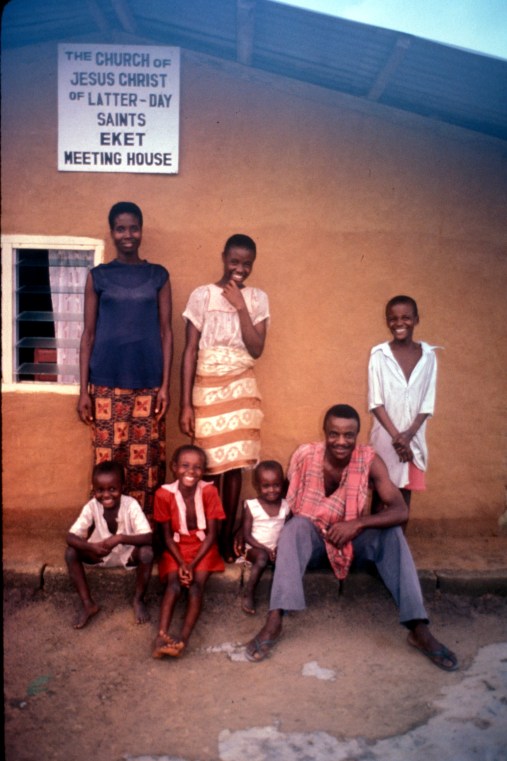
I was the Relief Society President in a tiny branch that met in this home in Eket. Samuel Dickson Paul (seated) was the Branch President. His wife, Cecilia, was my mentor and dear friend. I lived next door to this wonderful family for almost 3 years.During the years I lived in Nigeria, several missionary couples came to teach our friends and loved ones there. Here is one baptism we helped with. More than 60 villagers were baptized on this day, in 3 different sites in this river. It was the beginning of the church in West Africa. We had no idea what the future would hold. We were just little tools, doing what we could.Here I am with Mary Ellen Edmunds at the dedication of the first LDS chapel in Aba. Today there is a temple in Aba.
Last Sunday in our Gospel Doctrine class, we talked about the beginnings of the church in many lands and the miracles surrounding the saints and pioneers who were firsts. One of the pioneers mentioned was Anthony Obinna in Nigeria. As I sat listening in class, it occurred to me that I was a very small part of the miracles happening in Africa. I was a tool there, and at the time, I had no idea what the Church in Nigeria would look like, now 33 years later. My friends in Eket tell me there are now 5 Stakes in the region where we worked. It is almost unbelievable to me!
We each have small offerings, or tools to help build the kingdom, in the places we serve. We may never know the end of the story, or what the final outcome will be, we just help in whatever way we can, wherever we are called to serve.
Right now we are all called to serve here in the Washington Yakima Mission. Someday, maybe 30 years from now, we will look back on our areas and wards and stakes and remember what it was like when there were only 7 stakes here. Maybe we will realize then, the impact we had in building the kingdom here.
You can read more about our Nigerian Pioneer, Anthony Obinna here:
“You Have Come at Last”
Nigerian Builds LDS Congregation, Waits for Missionaries
Elizabeth Maki,
Anthony Obinna, top left
When the first Latter-day Saint missionaries arrived in Nigeria in 1978, there was very little need for proselytizing. For more than thirty years, Nigerians who had encountered the Church in one way or another had been writing Salt Lake City requesting literature and missionaries. When those missionaries came, they found multiple congregations eager to be baptized virtually the day they arrived.
Anthony Obinna, 1988
Anthony Obinna had been writing Church headquarters for several years by the time Rendell and Rachel Mabey and Edwin and Janath Cannon sought him out a week after their arrival in Nigeria in November 1978. The two senior missionary couples set off in a cab from Port Harcourt with only a general idea of their destination. Like many in Nigeria, Obinna lived in a numberless house on a nameless street, but the missionaries knew his village, county, and state from the letters he had written. After a three-hour ride including several stops to ask for help, they turned down a road lined with banana and palm trees that ended at a small church.
“Near the roof in blue letters were painted the words, ‘Nigerian Latter-Day Saints,’” Rendell Mabey later wrote. He found one set of doors labelled LDS and another labelled Missionary Home. “It was a curious experience encountering the name of our own church,” wrote Mabey, “where no missionary had ever before set foot.”
The missionaries found the area filled with people, but not Obinna. Upon learning who their visitors were, Obinna’s son went in search of his father while the missionaries explored the church.
The Mabeys admired the small chapel with its neat blue door and shutters, then explored the classroom which doubled as an office in the other half of the building. In the classroom, the program for the next day’s services were already carefully written up on a blackboard. A copy of the Doctrine and Covenants and several copies of the Book of Mormon were available for student use, and shelves were stacked with old issues of the Ensign and Church News.
It took a couple of hours for Obinna, who had built up this place over thirteen years of waiting, to arrive and finally shake hands with someone prepared to bring him the LDS Church in full.1
An Astonishing Discovery
More than a decade earlier, Obinna had a dream in which a man appeared to him and took him to a beautiful building he had never seen before. Obinna was taken inside and shown everything there. Later, the same dream came again.
Then, a few years later, during the Nigerian civil war, Obinna was confined to his home for safety. He picked up an old copy of Reader’s Digest and was stunned to see the very building from his dream as the centerpiece of an article about the LDS Church.
“I had never before heard the word Mormons,” Obinna wrote. “From the time I finished reading the story, I had no rest of mind any longer. My whole attention was focused on my new discovery. I rushed out immediately to tell my brothers, who were all amazed and astonished to hear the story.”2
It would be another year before the political situation in Nigeria allowed Obinna to get a letter out to the headquarters of the Church, so it wasn’t until 1971 that Obinna wrote Salt Lake for instructions. He received several pamphlets and a Book of Mormon, but was told the Church was not organized in Nigeria and that, as of that time, there were not yet plans to do so.
“I was totally disappointed,” Obinna recalled, “but the Holy Spirit moved me to continue writing. Many a time in dreams I saw some of the missionaries of the Church discussing matters about the Church.”
He continued to write, and while his patience was sometimes tried, he didn’t give up on the testimony that had been kindled inside him.
“We are not disencouraged anyhow but shall continue to pursue the practice of our faith which we have found to be true,” he wrote in 1976 in response to another letter urging Obinna to do the best he could on his own for the time being. “We are very optimistic that Our Lord Jesus Christ will make it possible in future for the Church to take more direct action. We are well aware that our faith is being tried. We are doing everything we can to establish the truth among so many of Our Heavenly Father’s children in this part of the world.”3
Indeed, Obinna taught the gospel to his family and had amassed a congregation of seventy-one members by the time the Mabeys and Cannons arrived five months after President Spencer W. Kimball announced a revelation removing the priesthood restriction that had long been an impediment to missionary work in West Africa.
Patience Rewarded
When Anthony Obinna arrived to greet the missionaries on that November day in 1978, his demeanor was serious, even thoughtful.
Elder Mabey was struck by how “solemn, gentle, and dignified” Obinna was as he entered the small church, “as though an overt display of enthusiasm at such a moment might be almost sacrilegious. Our eyes, however, were moist. We all felt movingly the richness of God’s Spirit.”4
Said Obinna, “It has been a long, difficult wait, but that doesn’t matter now. You have come at last.”5
Yet even Obinna’s patience had its limits; when Mabey told him there were other congregations the missionaries needed to visit and estimated that it would be six weeks before they could return to perform baptisms, Obinna’s waiting was done.
“’No, please,’ he said quietly,” Mabey later wrote. “‘I know that there are many others, but we have been waiting for thirteen years.’ His eyes were filled with longing. ‘Please, if it is humanly possible—go ahead with the baptisms now!’ For a few seconds we merely sat there looking into each other’s eyes. ‘Are most of your people ready?’ I asked at last. Anthony nodded emphatically. ‘Yes—absolutely yes! They know, as I do, that the gospel has been restored, but we must have guidance and direction. Let us baptize those strongest in the faith now and teach the others further.’ The Spirit was very strong, the man’s goodness and testimony clearly evident. ‘In that case,’ I said, ‘we will conduct the baptism as soon as possible.’”6
The men decided on a date just three days away, and on Tuesday, November 21, 1978, nineteen Nigerians were baptized in the Ekeonumiri River. Anthony Obinna was first.
A branch was soon organized for the new converts, with Anthony Obinna as its president, his brothers Francis and Raymond as his counselors, and his wife, Fidelia, as Relief Society president.7
After many years of waiting and hoping, Obinna penned a different sort of letter to Salt Lake soon after his baptism.
Anthony and Fidelia Obinna at the Logan Temple
“The entire members of the Church of Jesus Christ of Latter Day Saints in this part of Nigeria have the pleasure to thank you and the Latter Day Saints throughout the world for opening the door for the Gospel to come to our people in its fullness,” he wrote. “We are happy for the many hours in the Upper Room of the Temple you spent supplicating the Lord to bring us into the fold. We thank our Heavenly Father for hearing your prayers and ours and by revelation has confirmed the long promised day, and has granted the holy priesthood to us, with the power to exercise its divine authority and enjoy every blessings of the temple. … There is no doubt that the Church here will grow and become a mighty centre for the Saints and bring progress enough to the people of Nigeria as it is doing all over the world.” 8
Obinna served faithfully in the Church for many years, and in 1989 was sealed to Fidelia in the temple during a visit to Logan, Utah, where their son was living. Obinna died in 1995, leaving a legacy that was not limited to the dozens of family members to whom he had brought the gospel.
“The seed of the gospel which you sowed will grow into a giant tree,” he wrote to Rendell Mabey when his time in Nigeria was nearing its end. “The Church in Nigeria will surprise the world in its growth. The number of baptisms, confirmations, and ordinations you performed in this country show only a beginning.”9
In the middle of a crazy busy month of returning about 50 missionaries home after their work here was completed, and receiving about 60 new missionaries, we packed and sent about 1500 beautiful Days for Girls kits to Utah for distribution from there and today we prepared another 1,280 more kits for shipment in a cargo container heading to Uganda to help with the Sudanese refugees there.There’s something very Yakima-ish sweet about packing kits in apple boxes! We are in the middle of apple harvest here. These boxes will protect these kits on their long journey to women and girls desperately waiting for them on the other side of the world.Gathering finished kits–these are from Wenatchee:Some of the kits going to Utah:Packing kits for Uganda:Sometimes I just feel overwhelmed and exhausted by the goodness that surrounds me. Thanks to all who are helping us help so many girls in need.
The Assistants found a selfie stick in their truck and brought it over to me. They said, “Sister Lewis! Now you can be in the group photos at Zone Conferences!” The first try didn’t go so well. Figuring out the angle was like dancing backwards in a mirror. I finally gave up and one of the Sisters took a few photos for me, painlessly.
When I got home and downloaded the photos from my phone, I discovered 481 photos, taken split seconds apart. This was the first one and the only one worth saving. The other 480 were all over the place–I had no idea I was even taking them. I’m posting this one here for the record. Another skill to master.
From our Sunday School lesson today:
Referring to the pioneers, President Hinckley said: “I will never get over being thankful to them; I hope you never get over being thankful to them. I hope that we will always remember them. … Let us read again and again, and read to our children or our children’s children, the accounts of those who suffered so much” (Church News, 31 July 1999, 5).
As I have time, I’ve been reading from and extracting from the journal of John Bushman, my 2nd great-grandfather’s brother. He was a wonderful record keeper, writing in 3rd person about his life and his interactions with others. John Bushman kept small diaries, pocket-sized, throughout his life. Then in 1918, he transcribed them into a record book for his posterity. Below is the beginning page. This record book has 1197 pages. I’m taking screen shots of entries in this original compiled record in his own handwriting of all of the vital family information. Then I can attach these images to those individuals in FamilySearch.
It is my hope that these stories of faith and fortitude can be read again and again, and read to our children and to our children’s children. John Bushman’s faith strengthens mine. I hope my faith will strengthen someone else someday, far in the future after I am gone. This is why I continue writing my fingers to the bone.
On Journal Writing, from the London Magazine, reprinted in the Deseret News 16 July 1862
From the Deseret News, July 16, 1862
If a man keeps no diary, the path crumbles away behind him as his feet leave it; and days gone by are but little more than a blank, broken by a few distorted shadows. His life is all confined within the limits of today. Who does not know how imperfect a thing memory is? It not merely forgets; it misleads. Things in memory do not merely fade away, preserving as they fade their own lineaments so long as they can be seen; they change their aspect; they change their place; they turn to something quite different from the fact.
In the picture of the past, which memory unaided by any written record sets before us, the perspective is entirely wrong. How capriciously some events seem quite recent, which the diary shows are really far away; and how unaccountable many things look far away, which in truth are not left many weeks behind us! A man might almost as well not have lived at all, as entirely to forget that he has lived, and entirely forget what he did on those departed days. But I think that almost every person would feel a great interest in looking back day by day upon what he did or thought that day twelve months, that day three or five years ago.
The trouble with writing the diary is very small. A few lines, a few words, written at the time, suffices, when you look at them, to bring all (what the Yankees call) the “surroundings” of that season before you. Many little things come up again which you know quite well you never would have thought of again, but for your glance at those words, and still which you feel you would be sorry to have forgotten.
There must be a richness about the life of a person who keeps a diary, unknown to other men. And a million more little links and ties must bind him to the members of his family circle, and to all among whom he lives. Life to him, looking back, is not a bare line, stringing together his personal identity; it is surrounded, intertwined, entangled with thousands and thousands of slight incidents, which give it beauty kindliness, reality.
Some folks’ life is like an oak walking stick, straight and varnished; useful, but hard and bare. Other men’s life (and such may yours and mine, kindly reader, ever be), is like that oak when it was not a stick but a branch, and waved, leaf-enveloped, and with lots of little twigs growing out of it, upon the summer tree. And yet more precious than the power of the diary to call up again a host of little circumstances and facts, is its power to bring back the indescribably but keenly felt atmosphere of those departed days. The old time comes over you. It is now merely a collections, an aggregate of facts, that comes back; it is the soul of days long ago; it is the dear Auld lang syne itself! The perfume of Hawthorne hedges is there; the breath of breezes that fanned our gray hair when it made sunny curls, often smoothed down by hands that are gone; the sunshine on the grass where those old fingers made daisy chains; and snatches of music compared with which anything you hear at the opera is extremely poor. Therefore keep you a diary, my friend. –London Magazine
My dear friends, Melissa Clark and Wendy Barton are with Celeste Mergens today in Utah, where more than 5000 DfG kits will be assembled, breaking a Guinness World Record. What they have done to prepare for this day is almost incomprehensible. Imagine the numbers of the parts and pieces, each made and assembled with love by women all over the valley. I am thrilled and proud to know these women and to cheer them on from Yakima.
Today I cried a bit as I heard this video clip, sharing their DfG love from Utah:
Here we are today, doing our little part in the WYM. This is the group in Wenatchee, with some of our missionaries:
My mother, Grace Laemmlen, was a school teacher. After she and my dad married in June 1954, they traveled to Hagerstown, Maryland where my dad served for two years as the administrator of the hospital at Brook Lane Farm. As a Mennonite, he was a conscientious objector and this was part of his 2 year voluntary service. My mother found this teaching position nearby in Leitersburg at the Washington School.
Here are some wonderful photos of my mom and her school room and the beautiful children she taught.
My mother had perfect penmanship.
The Pigley-Wigley Store
I love these three class pictures. They give me a feel for the wiggly children mom taught!
Here are a few newspaper articles that mention mom as a teacher in Leitersburg in 1955/1956:
Here is a look at the Washington School back then:
Today this beautiful school is a well-known haunted house, having been abandoned long ago by school children. How much better to hear happy children’s voices in the hallways, than frightened ones.
I loved growing up with a mom who was a school teacher. She taught me to read before I went to Kindergarten. When I was older I loved helping her set up her classroom every year before school started. She taught 3rd grade for years in Orange Cove, California at the Sheridan Elementary School. Then for several years she supervised student teachers for Pacific College in Fresno. She was a wonderful teacher and a mentor for teachers.
After 2 years of driving this wonderful Highlander, we hit 50,000 miles and we were told we’d have to trade it in before the value dropped. This car has served us well, as we’ve driven all over central Washington. MapQuest tells me it’s 2,500 miles from San Francisco to New York City. In 2 years, we’ve traveled equivalent of TWENTY cross-country trips!Approaching 50,000:So they brought us a new car last month. Another Highlander, this one is a blue-ish color. Here is our car lineup–our first mission car, the new mission car, and the Acura MDX we brought with us from home.
Let me describe the features in our new Mission car.
We have leather seats and seat warmers this time. We also have a key-less starter. The car key (it’s really a fob) just has to be in the area (in our pocket or close by) to get into the car or to start it. You put you foot on the break and push a start button. Wow. It also has a radar feature. If you cross the center or side lines, it beeps at you to make sure you’re awake. And if there’s a car in your blind spot, the side mirrors flash a warning.
If you’re using cruise control, and you come up on a slower-moving vehicle, it slows you down automatically. It’s sensitive to what’s going on around you. It feels safer, but highly digital/technical. When you stop at a light and the car idles, after 3-4 seconds, the engine cuts to almost silence (it sounds like it turns off). I suppose it’s doing something to save gas or exhaust fumes.
It’s a comfortable nice car. But even with all of these snazzy features, my favorite feature is the shelf under the dash board where I can put my stuff–sun glasses, lip gloss, napkins, floss, receipts to turn in, and the gas cards. I love the shelf most of all.
How we pack when we go on the road:We are usually on the road most of the month, going to where our missionaries are. What a blessing to be so comfortable as we travel!